Explore research and projects from STEM Physical Sciences.

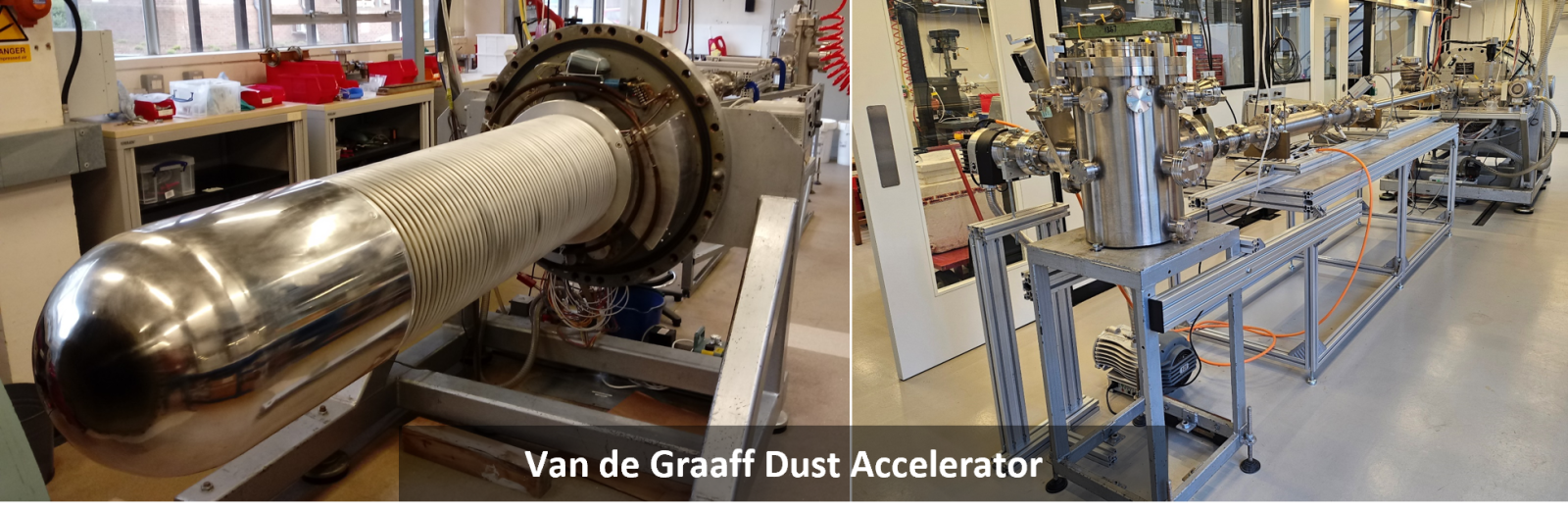
The Van de Graaff accelerator is used toaccelerate very small particles to hyper-velocities, in order to recreate theeffects of continual micrometeoroid dustimpacts as encountered on airlessbodies such as the Moon andEnceladus, as well as impacts onto X-ray imaging sensors and otherspacecraft components.
The Van de Graaff accelerator charges dust particles to ~+20 kV before injecting them into the accelerationtube, where they are exposed to an electric field of up to 2 MeV, causing the particles to accelerate tovelocities as high as 80 km/s. The particles then enter the drift tube, where they may be filtered, to removeparticles outside the desired velocity range for a given experiment. Finally, the particles enter a targetchamber, which accommodates both the target, as well as any supporting equipment and instrumentation.
The small target chamber can accommodate a 15 cm diameter surface analogue or spacecraft article. Forlarger targets, such as complete spacecraft instruments, the large target chamber (1 m diameter) is used.
| Energy | 2 MeV |
| Particle Size | 1 – 5 μm |
| Particle Material | Typically, spherical iron powder |
| Particle Velocity | 2 – 80 km/s |
| Target diameter | 1 – 80 cm |
The Van de Graff Accelerator includes:
For all enquiries please email: Manish Patel

