Discover teaching, research and people across STEM Physical Sciences.

Supervision team: Jimena Gorfinkiel (SPS) and Sam Eden (SPS)
Project description:
Electron attachment in condensed phases remains poorly understood despite its high relevance across diverse fields. Interatomic Coulombic Electron Capture (ICEC) is an environment assisted process in which a free electron efficiently attaches to an ion, atom or molecule. The excess energy due to the attachment is transferred to a neighbor which is thus ionized. ICEC was predicted in pioneering work in 2010 [1]; later on, the strong enhancement of the electron attachment due to ICEC in several systems was demonstrated computationally [2-5].
ICEC is an efficient process for reducing a species while oxidising one of its neighbors. Furthermore, the two species involved in ICEC can have different ionization potentials leading to a change in the energy of the free electron. Such electrons are known to be genotoxic through dissociative electron attachment (DEA) of biomolecules [6]. The cross section for DEA depends strongly on the kinetic energy of the free electron so in environments where it is operational, ICEC can enhance or quench the damage of living cells under ionizing radiation
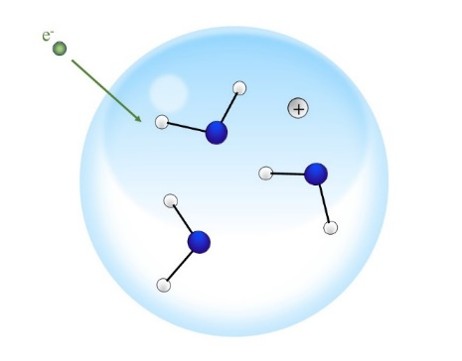
The aim of this project is to investigate the ICEC process in aqueous solutions and thus reveal its potential impact on radiation damage. The work will be performed in close collaboration with experimental groups in France who will perform synchrotron X-ray based measurements, as well as a theoretical group form the Sorbonne in Paris. By combining ab initio calculations and experiments we will determine the ICEC efficiency for metal cations in liquid water as a function of the initial electron kinetic energy distribution (created via the X-ray ionisation), the concentration and nature of the cation.
The project will use the R-matrix approach and the UKRmol+ suite [7], a well-established software suite developed by the OU group and collaborators that as already provided unparallel insight into ICEC. We will determine the cross sections required to quantify the ICEC quantum yield in solutions.
To model ICEC in aqueous solutions, we will use the semiclassical approach developed by the Sorbonne group [8]: the water molecules, the electron and the cation are treated as classical particles, with their interactions described by optimized potentials. The solvent consists of a simulation box of water molecules; periodic boundary conditions are applied to simulate an infinite system. The classical Hamilton equations of motion are solved for a swarm of trajectories representing the initial distribution of free electrons and cations in solution. The ICEC cross sections are a necessary input for these simulations.
ICEC belongs to a recently discovered family of non-local processes, such as Interatomic Coulombic Decay and Electron Transfer Mediated Decay, which have attracted considerable attention in the last decade [9]. However, much less is known about ICEC because of the challenging task of describing it theoretically and measuring it. This project aims to overcome these challenges and advance our understanding of how ICEC contributes to electron attachment processes and affects DEA in loosely bound systems.
References:
Qualifications required: BSc 2:1, MSc or equivalent in Physics, Chemistry or Applied MAthematics

