Discover teaching, research and people across STEM Physical Sciences.

Supervision team: Prof. Mahesh Anand (mahesh.anand@open.ac.uk) , Dr. Ben Rider-Stokes and Dr. Richard Greenwood.
Collaborators: Mike Zolensky (NASA JSC), Marina Ivanova (Vernadsky Institute), Tomohiro Usui (JAXA), Neil Bowles (University of Oxford).
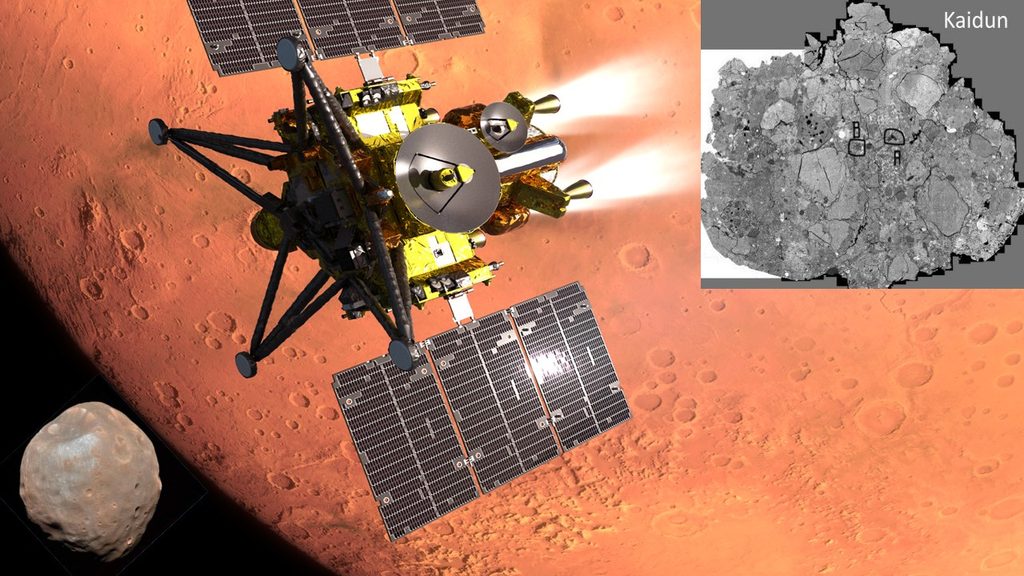
Artist’s impression of the JAXA MMX spacecraft which was successfully launched in October 2026. MMX will study the Martian moon Phobos (bottom left). Inset (top right): Thin section image of the Kaidun meteorite (Zolensky and Ivanov, 2003). Kaidun may share similarities to the regolith sample of Phobos that MMX will return to Earth in 2031.
Project highlights:
Project description: The origin of Phobos remains unresolved, with two leading hypotheses proposing either the capture of a primitive asteroid or formation from debris generated by a giant impact on Mars (e.g., [1]). Phobos’ low albedo and dark, primitive-asteroid-like reflectance spectra support the capture hypothesis. However, recent visible–near-infrared (Vis–NIR) observations have identified evidence for mafic silicates in Phobos’ blue unit, raising questions about whether its surface also contains differentiated material, potentially including Martian ejecta [2]. Such components may be difficult to detect when mixed with spectrally dominant dark, primitive material [3]. Distinguishing these possibilities is a key objective of JAXA’s Martian Moons eXploration (MMX) mission, successfully launched in October 2026 and due to return samples from Phobos in 2031.
The Kaidun meteorite provides a unique opportunity to investigate this compositional ambiguity. This exceptionally diverse polymict breccia contains primitive carbonaceous and enstatite chondritic lithologies alongside differentiated igneous clasts and impact products [4]. Its unusual combination of primitive material and alkaline-rich differentiated clasts led [5] to propose that Kaidun may originate from Phobos, although this hypothesis remains unconfirmed. Previous oxygen isotope measurements have demonstrated the diversity of its constituent materials, but the origins of many lithologies remain unresolved.
This project will use a correlative analytical approach to investigate Kaidun’s lithological diversity and evaluate its relevance to Phobos. Advances in microscale Vis–NIR spectroscopy of powders and intact material, in-situ mid-IR spectroscopy of thin sections and embedded samples, and high-precision triple oxygen isotope analysis offer opportunities to characterise increasingly small quantities of precious material. By combining low-vacuum SEM–EDS analysis of unprepared chips with reflectance spectroscopy of corresponding powders and targeted oxygen isotope measurements of selected clasts, the project will link texture, mineralogy, spectral properties and isotopic provenance. This will establish how primitive and differentiated components can be identified within complex mixtures and how their spectral signatures may inform the interpretation of Phobos.
The results will constrain the origins of Kaidun’s constituent lithologies, improve the interpretation of Phobos’ surface composition and develop correlative analytical approaches relevant to the analysis of samples returned by MMX. The student will gain interdisciplinary expertise in planetary spectroscopy, meteorite petrography, SEM–EDS and isotope geochemistry, contributing to the next generation of planetary sample-return science.
References: [1] Poggiali et al. (2022). Monthly Notices of the Royal Astronomical Society, 516, 465-476. [2] Munaretto et al. Submitted to Astronomy and Astrophysics. [3] Schultz & Milliken (2025). Icarus, 429, 116442. [4] Zolensky & Ivanov (2003). Geochemistry, 63, 185-246. [5] Ivanov (2004) Solar System Research 38, 97–107.
Qualifications required: BSc (hons) in Geosciences, 2:1 or higher (a first-class master’s degree in Geosciences or equivalent with some independent research experience would be preferred)

