Discover teaching, research and people across STEM Physical Sciences.

Supervision team: Dr Martin D Suttle, Dr Ben Dryer
Lead supervisor: Martin Suttle (martin.suttle@open.ac.uk)
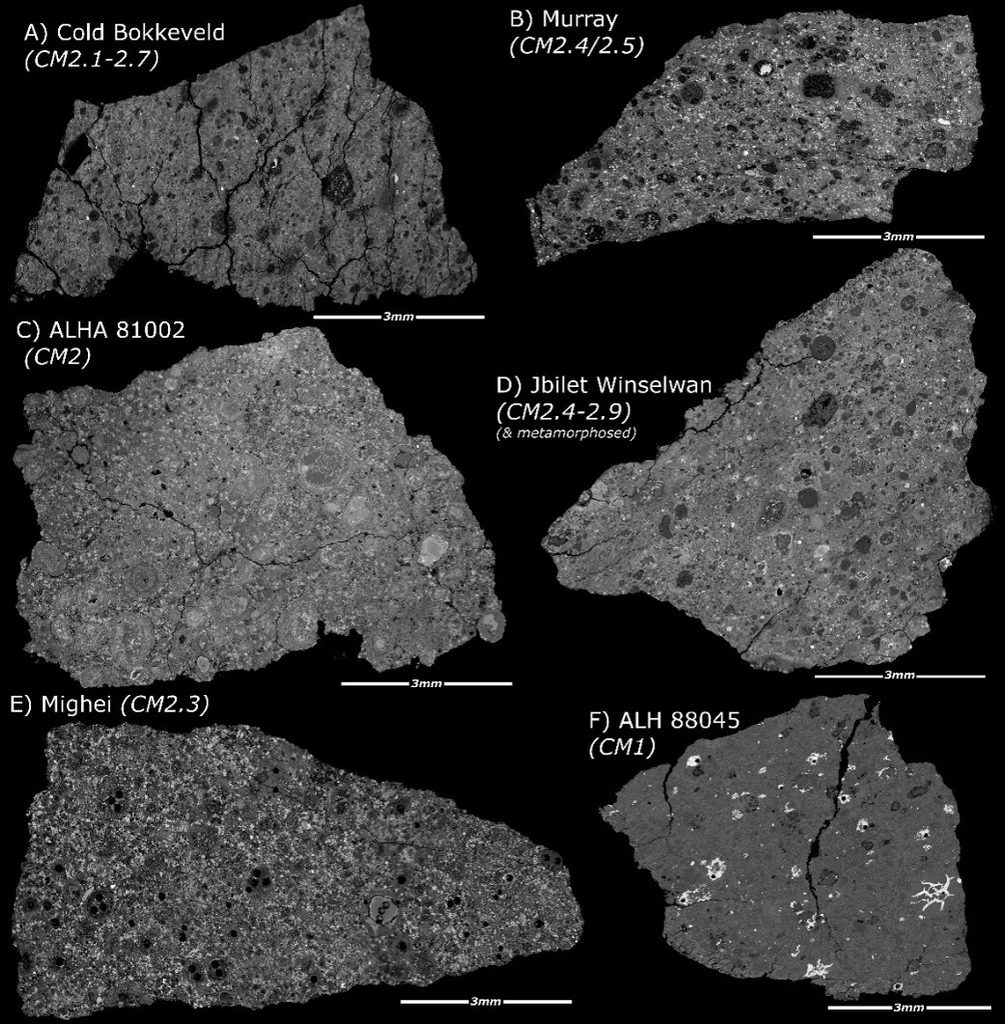
Fig.1. (Above) Polished sections of six CM chondrites viewed under SEM with BSE imaging. Samples are A) Cold Bokkeveld (CM2.1-2.7), B) Murray (CM2.4/2.5), C) ALHA 81002 (CM2), D) Jbilet Winselwan (CM2.4-2.9), E) Mighei (CM2.3) and F) ALH 88045 (CM1). The CM chondrite lithology has small chondrules (averaging ~300 mm) that occur at relatively low abundances (~20 vol%) in comparison to other carbonaceous chondrite groups. Scale bars are 3 mm.
Project highlights:
Project description: Carbonaceous chondrites are primitive meteorites that preserve chemical and mineralogical evidence of the earliest stages of planet formation in the outer Solar System. Most underwent extensive aqueous alteration, likely driven by radiogenic heating. During this process, primary anhydrous minerals reacted with liquid water to produce hydrated secondary phases (most significantly phyllosilicates, carbonates, and magnetite). These minerals retain oxygen isotope signatures inherited from the parent body fluids, providing an archive of ancient water composition as alteration evolved.
The initial oxygen isotope composition of water accreted by carbonaceous chondrites remains poorly constrained. Previous estimates span a wide range, reflecting our limited understanding of how oxygen was processed and distributed within the protoplanetary disc (e.g., Clayton and Mayeda, 1999; Fujiya, 2018). Resolving this uncertainty is critical to understanding how volatile elements were accreted, redistributed, and potentially lost during planet formation. The outcomes of this project will inform broad science questions (e.g., whether the delivery of water-bearing chondritic material into the inner Solar System was necessary for the origin of Earth’s oceans?)
For the best-studied hydrated chondrite groups (e.g., the CM, CR and CI chondrites), previous studies provide partial constraints on total water content, timing of alteration, and fluid behaviour (e.g., Suttle et al. 2025). These constraints, however, often come from isolated approaches focused on a single dataset (e.g., petrographic observations, thermal modelling, or oxygen isotope measurements of individual phases). By contrast, a unified quantitative framework that integrates diverse datasets is lacking. This PhD project aims to fill that gap.
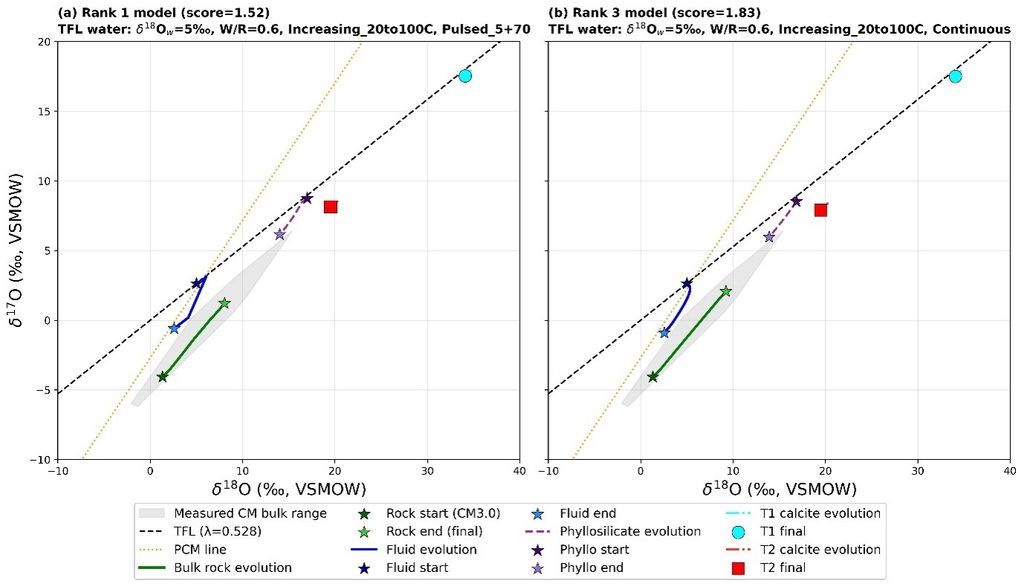
Fig.2. (Above) Two of the best-matching aqueous alteration scenarios for the CM chondrites from the model of Suttle and Babrián (2026). A) shows the best-matched (lowest score) scenario, which is a pulsed scenario, B) shows the third best-matched scenario which is also the lowest scoring continuous dissolution scenario. In both plots the green line and corresponding green stars track the changing rock composition, the blue line and corresponding blue stars represent the evolving fluid composition, and the purple line and corresponding purple stars track the phyllosilicate composition. A light blue circle and red square mark the average composition of the T1 and T2 calcite (respectively) that have formed in these scenarios. The measured CM bulk range is shown by a grey irregular polygon, while the gold dotted line denotes the Primary Chondrule Mineral (PCM) line, and the dashed black line marks the Terrestrial Fractionation Line (TFL).
The student would build upon a recently developed model that simulates oxygen isotope evolution during aqueous alteration on the CM chondrite parent body (Fig.2 and Suttle and Babrián, 2026). They will extend the model to incorporate additional processes (e.g., complex thermal histories, variable timing of secondary mineralisation, partial isotopic re-equilibration of secondary phases, and a wider range of secondary mineral constraints [e.g., magnetite and phyllosilicate]). Initial efforts will focus on the CM chondrites, though there is scope to develop into the CI or CR chondrites.
As a secondary objective, if viable the student will have the opportunity to acquire new oxygen isotope data using our in-house NanoSIMS instrument. They will analyse secondary oxygen-bearing phases (starting with magnetite), after having completed SEM and Raman-based petrographic characterisation. These measurements will directly inform model development by adding new secondary mineral constraints. The lab data therefore improves model outputs by enhancing discrimination of different alteration scenarios.
The results will determine whether different chondrite groups (e.g., CM, CR and CI) accreted water from isotopically unique sources, or a single outer Solar System water reservoir. Secondary objectives are to provide quantiative constraints on the geological evolution of these carbonaceous planestimals.
References:
Qualifications required: (Note: STFC requires at least BSc 2:1 or a MSc in a relevant discipline) – Prior experience with Python programming is required. An interest in isotope geochemistry, planetary materials and quantitative modelling is essential

