Discover teaching, research and people across STEM Physical Sciences.

Supervision team: Professor David Rothery, Dr Emma Caminti, Professor Mahesh Anand
Lead supervisor: David.Rothery@open.ac.uk
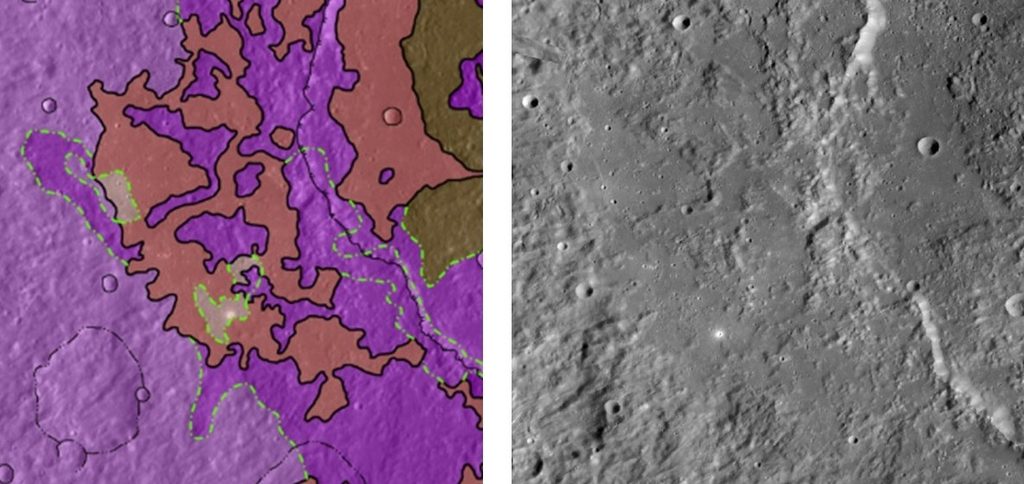
Left: Probable impact melt (pink) mapped near the rim of Mercury’s Rachmaninoff crater. Right: MESSENGER image basemap of the same area. Approx 100 km across
Project highlights:
Project description:
Smooth plains cover about 30% of Mercury’s surface. These are generally regarded as lava plains. Mercury’s impact history necessitates the presence of impact melt on its surface, but so far impact melt and lava have rarely been distinguished on Mercury with any confidence. For the Moon we have images of sufficient spatial resolution to recognise ejected impact melt cascading downslope into impact craters, but we currently lack sufficient spatial resolution on Mercury to make similar observations. Ambiguity between lavas and impact melt hinders our understanding of Mercury’s geologic and thermal history. However, the composition of impact melt should match the material from which it is formed, whereas lavas should have been fed by partial melting of the mantle – so it may sometimes be possible to distinguish lavas from impact melt using elemental and mineralogical abundances derived from BepiColombo data (Xray spectroscopy from BepiColombo’s MIXS instrument, and VNIR and TIR spectroscopy from BepiColombo’s SIMBIO-SYS and MERTIS).
In this project the student will work with visible imagery from NASA’s MESSENGER and ESA’s BepiColombo to map areas of candidate impact melt in and around craters, and use compositional data from MIXS, MERTIS and SIMBIO-SYS to document differences. Depending on the findings and the candidate’s interests and expertise, we envisage that this project could expand along either photometric or geochemical lines.
This is an exciting opportunity to work with newly arrived data from a spacecraft expected to deliver science from Mercury orbit April 2027-December 2029.
References:
Qualifications required BSc 2:1 or a MSc in geosciences or planetary sciences. GIS experience with ArcPRO or similar would be an advantage.

