Discover teaching, research and people across STEM Physical Sciences.

Supervision team: Karen Olsson-Francis, Vic Pearson and Alvaro Del Moral
Lead supervisor: k.olsson-francis@open.ac.uk
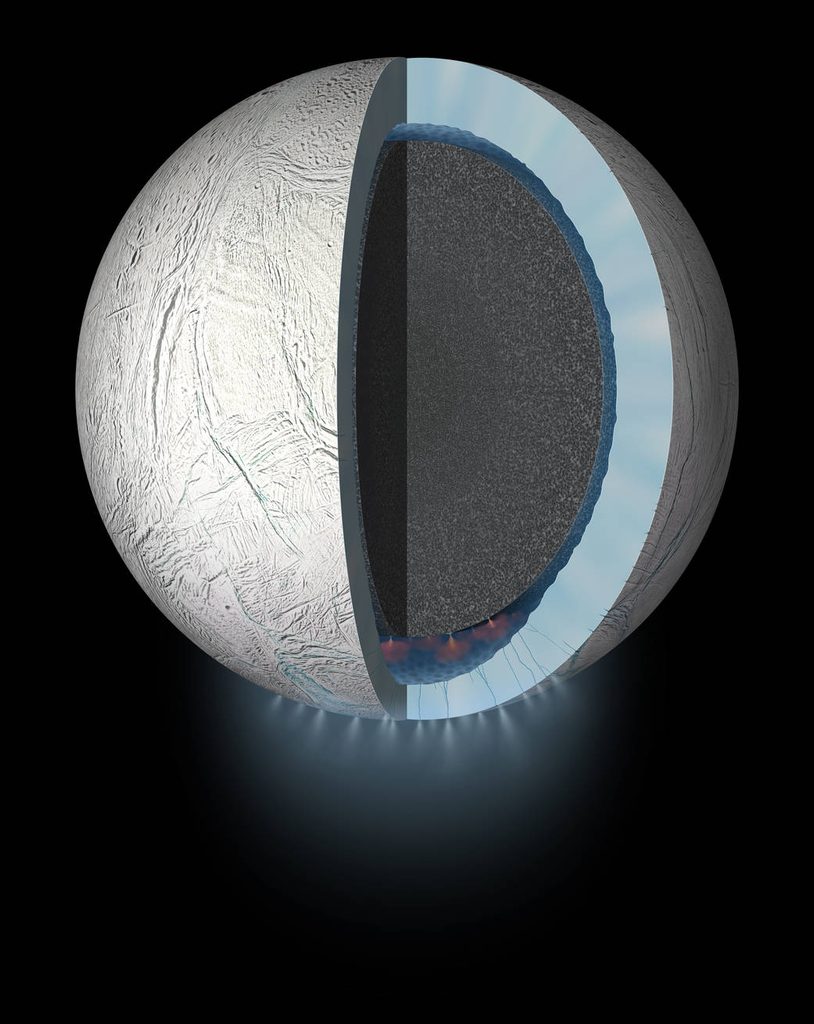
Figure 1: An artist’s rendering showing a cutaway view of the ocean and plumes of Saturn’s moon Enceladus (credit NASA).
Project highlights:
Project description:
Planetary protection aims to enable scientific investigations of habitable environments beyond Earth by preventing the unintended transfer of terrestrial microorganisms or organic molecules that could jeopardise the search for life elsewhere in the Solar System.
Among the most exciting targets for future exploration is Enceladus, an icy moon of Saturn with a subsurface ocean that can be analysed indirectly by sampling the plumes emitted at the moon’s south pole. These eject ocean-derived material into space (Figure 1) that has been analysed by past missions, indicating that this ocean may be habitable. The ocean’s physical and chemical conditions are within the known boundaries of life, and are coupled to an energy source that could drive microbial activity.
The upcoming ESA L4 (Large‑class Mission 4) will investigate the habitability of Enceladus and search for evidence of life. To protect the mission’s scientific integrity, it is crucial that Planetary Protection guidelines reflect current scientific understanding. The COSPAR international Policy on Planetary Protection1 has recently been updated, and the proposed mission needs to demonstrate a probability of inadvertent contamination carried by space hardware (temperature ≥ -28°C and water activity ≥ 0.5) of 1×10-41.
A probabilistic risk‑assessment framework is required to estimate the likelihood of forward contamination, incorporating factors such as the microbial burden present before launch, microbial survivability during transport, and the capacity for replication if introduced into the target environment2. A key part of developing a credible framework is determining whether microbial contaminants from Earth could survive transport and grow in Enceladus’s subsurface ocean.
Using simulation experiments, this studentship will examine the ability of microorganisms found within cleanroom environments to survive exposure to environmental conditions at the surface of Enceladus, and assess whether the subsurface ocean could support microbial growth if they migrated there.
The project will contribute to ongoing international planetary protection efforts to develop a probabilistic risk assessment framework for the ESA L4 mission. Such a framework will play a crucial role in informing planetary protection guidelines for future exploration.
References:
1. COSPAR. COSPAR Policy on Planetary Protection. Space Research Today 224, 17 (2026).
2. McCoy, K. J. et al. Europa Clipper planetary protection probabilistic risk assessment summary. Planet. Space Sci. 196, 105139 (2021).
Qualifications required: at least BSc 2:1 or a MSc in a relevant discipline in microbiology, molecular biology, planetary science, or a relevant discipline

