Discover teaching, research and people across STEM Physical Sciences.

Supervision team: James Holmes and Manish Patel
Lead supervisor: James Holmes (james.holmes@open.ac.uk)
Project highlights:
Project description:
The atmosphere of Mars is a complex and evolving system in which atmospheric circulation, dust activity, the water cycle and chemical processes are strongly coupled. Understanding these interactions is essential for interpreting spacecraft observations, reconstructing Martian climate and supporting future exploration. However, spacecraft measurements are often sparse in space and time, while numerical models have uncertainties in their representation of atmospheric processes. New approaches are therefore needed to combine observations and physical models more effectively.
Machine learning (ML) offers exciting opportunities to improve atmospheric simulations and forecasts, extract patterns from large observational datasets and accelerate computationally expensive calculations. However, purely data-driven approaches can struggle to generalise to poorly observed conditions or capture important physical relationships. Combining ML with physical models and data-assimilation techniques offers a promising route towards more accurate, efficient and physically consistent representations of the Martian atmosphere [1,2].
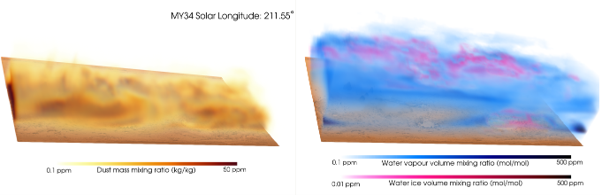
This project will develop and evaluate next-generation ML and data-assimilation methods for Mars, using the Open University’s Mars Global Circulation Model (GCM), existing atmospheric reanalysis datasets such as OpenMARS [3], and observations from past and present Mars missions. Possible approaches include hybrid physics-based and ML forecasting, ML-assisted data assimilation and improved representations of model uncertainty.
The specific scientific application will be developed with the successful candidate, allowing them to pursue their interests while addressing an important question in Martian atmospheric science. Potential case studies include assimilating wind measurements to improve atmospheric circulation, prediction of Martian dust storms, or combining trace-gas observations with modelling to better understand atmospheric chemistry.
The project will build on the Open University’s expertise in Martian atmospheric modelling, data assimilation and spacecraft observations, including data from the European Space Agency’s ExoMars Trace Gas Orbiter. The student will have opportunities to collaborate with atmospheric modellers, retrieval specialists and mission scientists, gaining transferable skills in machine learning, scientific computing and planetary science. The research will contribute new tools for interpreting spacecraft observations and improving our understanding and prediction of the Martian atmosphere.
References:
Qualifications required: (Note: STFC requires at least BSc 2:1 or a MSc in a relevant discipline)
Suitable for graduates with a computer science, physics, mathematics, or related numerate undergraduate degree. Experience or interest in machine learning, scientific computing, atmospheric science or numerical modelling would be advantageous.

