Explore research and projects from STEM Environment, Earth and Ecosystem Sciences.

We provide specialist facilities, technical expertise and analytical services to support the study of Earth and environmental materials, including but not limited to rocks, minerals, sediments, fossils and archaeological samples. We work closely with researchers, students, industry partners and external organisations, offering access to sample preparation, characterisation and chemical analysis capabilities.
We welcome collaboration with external users from academia, industry, museums, heritage organisations and government agencies. Offering routine analysis, bespoke method development, technical advice or support for research projects. Our laboratories comprise a range of analytical instruments and sample preparation facilities across the following areas:
We offer a comprehensive thin section and sample preparation service for a wide range of materials, including rocks, ceramics, meteorites, coal, clays, mineral grains, single crystals, and building materials. Our facilities produce both standard and large-format thin sections tailored to the requirements of geological, archaeological, environmental, and materials science applications.
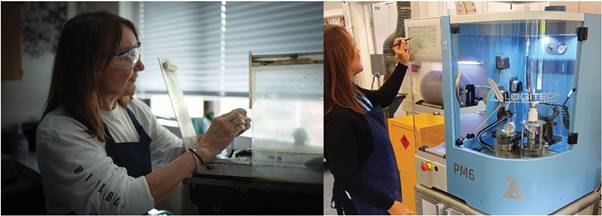
Standard polished thin sections (25 mm × 48 mm) are available for optical microscopy, electron microscopy, and other microanalytical techniques, with options for detachable mounts and double polishing where required. We also prepare polished 1-inch resin mounts for electron microprobe, SEM, and other analytical workflows.
Additional preparation services include resin impregnation, blue-dye impregnation, and carbonate staining to assist with mineral identification and petrographic interpretation, ensuring samples are optimally prepared for detailed analysis and imaging.
Please contact Kay Knight (Kay.Knight@open.ac.uk) for further information about the thin section laboratories.
The Virtual Microscope broadens access to rock collections currently held in museums, universities and other institutions around the world. The virtual microscope allows users to examine and explore minerals and microscopic features of rocks, helping them to develop classification and identification skills without the need for high-cost microscopes and thin section preparation facilities.
Please contact Tom Argles (Tom.Argles@open.ac.uk) for further information about the Virtual Microscope.
We also have sample preparation, processing and microscopy facilities to support geological, environmental, sedimentary, palaeontological and materials research. Our laboratories are equipped for rock crushing and milling, with facilities including a rock splitter, jaw crusher and milling equipment. We also maintain dedicated sedimentary and palaeontological laboratories for the storage, preparation and analysis of samples, featuring a sediment core splitter, walk-in cold storage, freezer, extractor hoods for acid digestion, centrifuge, drying ovens, precision balances, water baths, hot plates and a high-purity water supply.
Complementing these preparation facilities, our microscopy laboratories provide a range of instruments for the investigation of geological and environmental materials. These include specialist microscopes for micropalaeontological analysis of palynomorphs, foraminifera, diatoms, insects and other microfossils, alongside petrographic microscopes for the examination of thin sections in reflected and transmitted light. Additional facilities include an inverted microscope with a micromanipulation system for the rapid picking and isolation of microfossils, a six-figure microbalance for the precise weighing of small samples, and digital image analysis systems for the quantitative measurement and characterisation of microscopic specimens and structures.
Our Inductively Coupled Plasma (ICP) facility specialises in the elemental analysis (metals and selected non-metals) of routine and non-standard samples using state-of-the-art ICP-OES, ICP-MS and LA-ICP-MS instrumentation. Combining technical expertise with method development capabilities, we are open to work closely with researchers and industry to develop customised methods that deliver reliable, high-quality data.
Please contact Sam Hammond (Sam.Hammond@open.ac.uk) (solution analyses & geochemical clean lab), Barbara Kunz (Barbara.Kunz@open.ac.uk) (laser ablation analysis), Josh Oakley (josh.oakley@open.ac.uk) (ICP-OES) for further information about the ICP-facility.
What can we analyse?
We provide analytical services for a wide range of non-metallic or low-metal content samples, including:
✔ Rocks & Minerals (as chips, grain or powders)
✔ Soil
✔ Liquids
✔ Biogenic materials (shells, foraminifera, fossilised bones and teeth)
✔ Wood & fabric
✔ Some ceramics (depending on composition)
Unfortunately, we are unable to analyse metals, oils, and plastics due to their incompatibility with our existing research and other contracts.
Our dedicated metal-free clean laboratory suite supports ultra-trace elemental and isotopic analysis. The facility is equipped with PicoTrace Clean-Airworkstations fitted with electronically controlled PTFE hotplates and supplied with 18.2 MΩ·cm ultrapure water. A dedicated weighing laboratory houses both five- and seven-decimal-place analytical balances for high-precision sample handling.
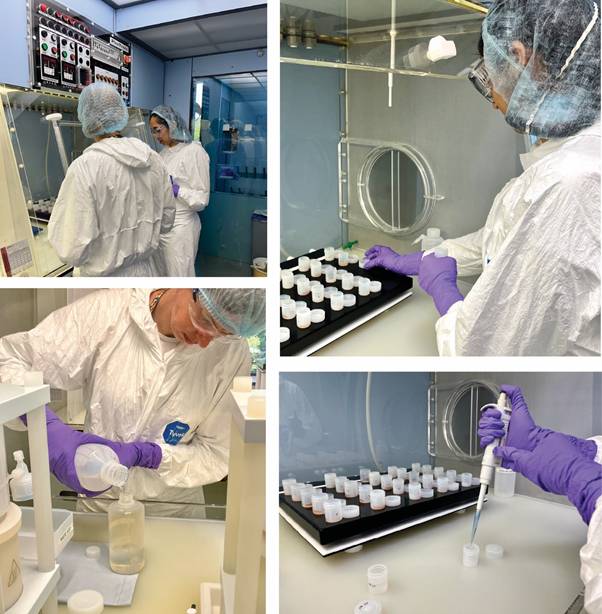
These facilities provide a low-contamination environment for sample dissolution, chemical separation and element purification, ensuring the analytical accuracy and precision required for trace element and isotopic measurements. These labs also support chemical cleaning of biogenic materials (e.g. Foraminifera and shells) and preparation of matrix matched multi-trace elements standard for precise elemental ratios for Foraminifera and other calcareous materials for palaeoclimate reconstructions.
Our Agilent 5110 Inductively Coupled Plasma Optical Emission Spectrometer (ICP-OES) provides rapid, multi-element analysis of a wide range of liquid samples, including aqueous solutions, brines, digests and environmental extracts. The instrument is capable of quantifying both major and trace element concentrations across diverse sample matrices.
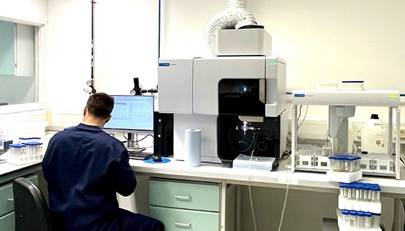
The system offers high analytical accuracy, precision and throughput through automated sample introduction and simultaneous multi-element measurement. It is routinely used for the analysis of environmental, geological and industrial samples, supporting both research and commercial applications.
Our Agilent 8800 Triple Quadrupole ICP-MS (ICP-QQQ) provides high-sensitivity trace element analysis across the periodic table, from lithium to uranium, in a wide range of geological and environmental materials, including rock digests, soils, marine biogenic materials (e.g. Foraminifera) and waters.
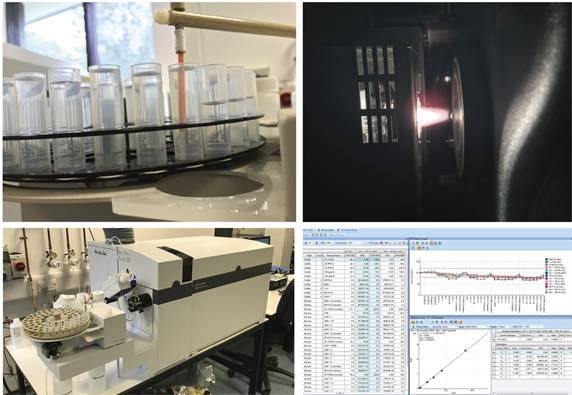
The triple quadrupole configuration enables the effective removal of complex polyatomic, doubly charged and isobaric interferences, allowing accurate determination of elements that are traditionally challenging to measure by conventional ICP-MS, such as sulphur, selenium and silver. This capability also supports specialised applications including high-precision trace element analysis (e.g. rare earth elements) and Rb-Sr geochronology.
Our Photon Machines Analyte G2 193 nm excimer laser ablation system, coupled to our ICP-MS system is equipped with a HelEx II two-volume ablation cell, which enables high-resolution, spatially resolved elemental analysis of solid materials (e.g. minerals, Foraminifera). The system accommodates up to four standard glass slides and three grain mounts, or nine grain mounts, in a single analytical session, providing the ability to analyse samples with minimal sample changes.
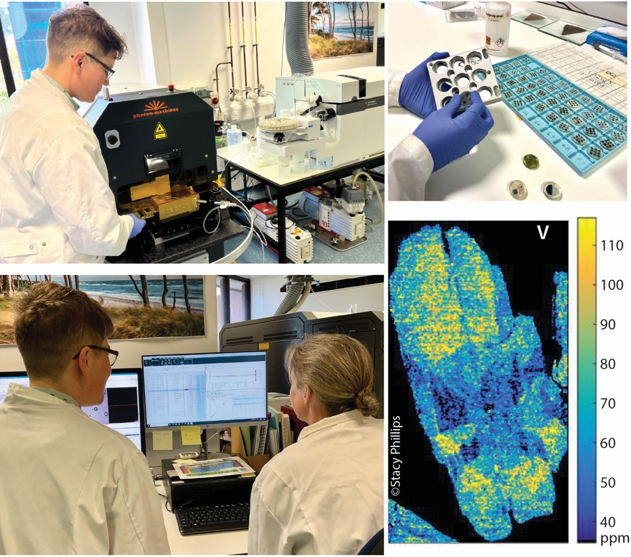
The dual-volume ablation cell delivers rapid aerosol transport and fast signal washout, minimising signal dispersion and improving analytical precision. Integration with the Teledyne Aerosol Rapid Introduction System (ARIS) further enhances aerosol transport efficiency and washout performance, enabling high-speed, high-resolution elemental mapping while maintaining full signal peak resolution.
Ar/Ar and Noble gas mass spectrometry
Our MAP 215-50 and Nu Instruments Noblesse mass spectrometers are fully compatible with our mobile laser units including two Infra-Red fibre lasers, a Photon Machines 193nm excimer laser and a CO2 laser system.
Together these allow analysis of a wide range of materials. We are dedicated to developing and modifying techniques for dating ultra-small samples to high precision, and ultra-high resolution noble gas diffusion experiments.
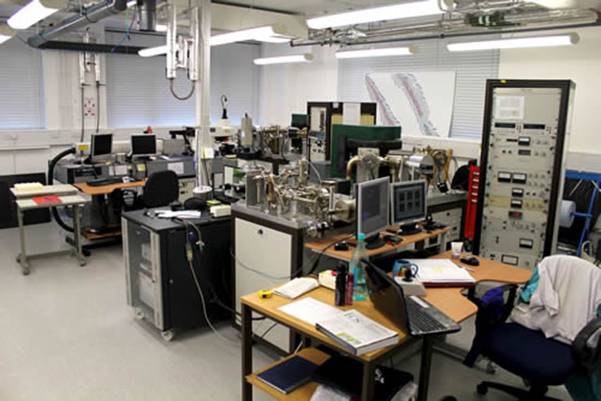
Please contact Sarah Sherlock (sarah.sherlock@open.ac.uk) for further information about the Ar/Ar and noble gas analysis.
The Stable Isotopes and Geochemistry Laboratory, equipped with a Elementar PrecisION ISOprime and a MAT253 IRMS, is housed in the School of Physical Sciences and offers isotopic (C, O, N, H) analysis of organic (including compound specific isotope analysis), terrestrial and marine inorganic carbonate materials and extra-terrestrial samples. We measure a wide range of materials: soil and sediments from ocean sediment cores, impact craters, lake beds, rock deposits, shells, plants, lunar samples and meteorites.
Please contact Simona Nicoara (Simona.Nicoara@open.ac.uk) and Pallavi Anand (pallavi.anand@open.ac.uk) for further information about the stable isotope analysis facilities.
The OU Electron Microscopy Suite offers high-resolution imaging, large-area elemental mapping, EDS chemical analysis, and specialised techniques including Electron Backscatter Diffraction (EBSD) and Cathodoluminescence (CL). Together, these capabilities provide detailed insights into the composition, structure, and evolution of a wide range of geological and material samples.
Our Cameca SX100 Electron Microprobe complements these capabilities with high-precision quantitative elemental analysis. Equipped with both Wavelength Dispersive Spectroscopy (WDS) and Energy Dispersive Spectroscopy (EDS). The sample holder accommodates up to four thin sections or six 1-inch mounts simultaneously, enabling efficient analysis of multiple samples while delivering robust and accurate compositional data.
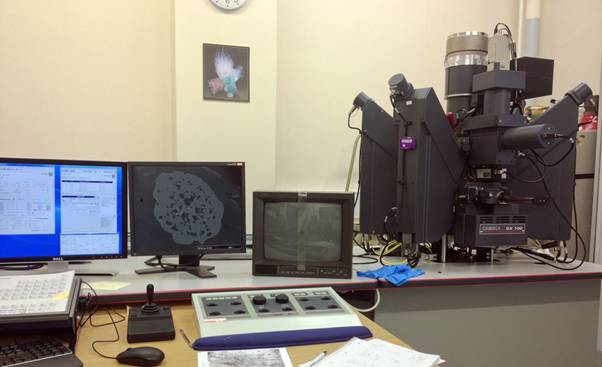
Please contact Lee White (Lee.White@open.ac.uk) or visit the Electron Microscope Suite homepage for further information about the SEM and EMPA facility.
Our Niton XL3t handheld XRF instrument can be used for both field and laboratory-based measurements of elements in solid rock samples, bulk sediments and powders. The instrument can analyse elements as light as Mg, Si and S, through to trace elements such as Pb, Mo and V. We have a suite of international reference materials with known chemical composition which enables us to quantify elemental composition. Detection limits are well below the average crustal composition for most measured elements.
Please contact Alison Halton (Alison.Halton@open.ac.uk) for further information about the XRF.

