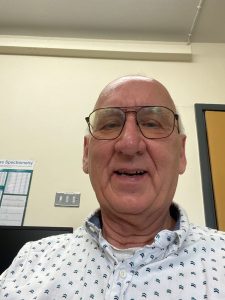
Meet the people who make up STEM Faculty.

Peter Taylor did his BSc and PhD many years ago at the University of East Anglia. This was followed by a brief spell (1976-78) as a postdoctoral Researcher at Exeter. He joined the Department of Chemistry at the Open University in 1978 and has stayed at the OU ever since. He was promoted to Senior Lecturer in 1993 and to Professor of Organic Chemistry in 2005.
He has been research active throughout this time and has always had at least one student and/or Post Doc for the last 40 years. At present he has one Ph. D. student and one Post Doctoral Fellow. In recent years he has been more interested in working with industry and has had 3 KTPs and a CASE award.
Peter has been involved in the production and presentation of a large number of courses within and without the Science Faculty. However, towards the end of his career he spent most of his time in a more senior University role. He was the academic lead on the Academic Principles for Qualifications project. He was Deputy Chair of the Academic Quality and Governance Committee and the Module Results Approval and Qualification Classification Panel and chairs of numerous committees and projects around assessment issues, for example he was the academic Director of the Assessment programme. He was Director of the Open Programme which had over 25 000 students. He was an Associate Lecturer of the project module S810.
In the recent past he has had funding from Wellcome and NESTA for outreach projects around Open University Science broadcasting. He was the academic lead for the TV series "Rough Science" and more recently one of the Academic leads on the radio series "Inside Science"
Peter is a past chair of the Travel Grants Committee of the Royal Society of Chemistry and was chair of an American Chemical Society named award Committee. He recently finished a 4 year Tempus project (900 000 euros) on developing e-learning capacity in Kazakhstan and Uzbekistan.
Peter is a Principal Fellow of the HEA
Synthesis and reactions of silsesquioxane cages
Peter's work has focussed on preparing a range of silsesquioxane cages with regular structures and to examine their synthesis and interconversions.
Such compounds have been prepared with a range of functionality on each arm. For example, liquid crystalline materials have been prepared using suitably substituted linear arms. Previous work has involved cages with DNA strands attached that act as diagnostic devices, and cages with ligands that complex metal ions for imaging. We have also examined the phase changes associated with cages with long alkyl arms using WAX, SAX (Diamond), DSC and measuring their liquid crystal properties.
These cage compounds are prepared using a high yielding route from the corresponding triethoxysilane. Careful control of the reaction conditions leads to cages with a fluoride ion trapped in the centre. For a while we could only encapsulate fluoride with cages that contain an sp2 carbon. latterly we have continued the synthesis of encapsulated species where the arm is connected via an sp3 carbon which is attached to an electron withdrawing group. This has led to a number of interesting compounds where both the cation and anion are contained within cages leading to molecular ionic compounds, for example, potassium fluoride where the cation and anion are encapsulated.
The types of arms we use for attaching to silsesquioxane cages are similar to those attached to silica in HPLC. We had a partnership with Hichrom a manufacturer and distributor of HPLC columns to create new phases.
We had a CASE award student, in collaboration with TWI, examining silsesquioxane coatings.
Our most recent work has focussed on attaching protein arms to silsesquioxanes to create bioactive molecules.
Mechanistic silicon chemistry
We have been interested in substitution at silicon for over thirty years. In particular we made a range of pentacoordinate silicon compounds and examined their structures and reactions. We designed an NMR method for mapping substitution at silicon in solution based on using pentacoordinate structures as models (similar to the Dunitz approach with X-ray). We also prepared a pentacordinate silicon polymer.
Synthetic Organosilicon chemistry
We had a three year KTP with Cornelius Enterprises. This focussed on developing their catalogue of organosilicon intermediates and involved developing cost effective routes to particular targets followed by scale up. As well as developing materials for contact lenses, we also aimed to prepare intermediates for electrical components and healthcare products.
Biological silicon chemistry
We have discovered the first unambiguous example of enzyme catalysed Si-O bond formation and cleavage. Most of the work has focussed on monoalkoxytrialkylsilanes and so the outcome has been easy to follow by gc. We are now examining the outcome of enzyme catalysed hydrolysis/condensation of di, tri and tetra alkoxysilanes. We have also engineered phages that have silaffin proteins on then outer coat that precipitate silica.
Peter impact and engagement is mainly focussed on working with Industry. In recent years he has had three Knowledge Tranfer Partnerships as well as a CASE award. He has numerous collaborations with a range of Industries that use organosilicon chemistry and developed a network of SMEs that use organosilicon compounds.
Most of Peter's external collaborations are with Industry and professional bodies.
Peter has been part of international projects in India, Uzbekistan, Kazakhstan, Russia, Brazil and China.