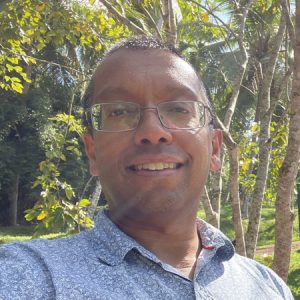
Meet the people who make up STEM Faculty.

I am a Professor of Software Engineering at the Open University whose research addresses the practical problems associated with building and maintaining self-managing (adaptive) systems by combining rigorous formal techniques with concrete implementations and applications of those techniques. I completed my PhD at Imperial College London, UK in 2005, prior to which I worked as a senior software engineer at Sapient Corporation, USA.
During my career, I have published over 100 peer-reviewed papers which include 4 that won Best Paper awards. My interdisciplinary research bridges software engineering with social psychology, business strategy, human-computer interaction, healthcare, and machine learning. As a result, I have contributed to advances that have impacted application domains that include online social networks, enterprise systems, policing, the internet of things and mobile applications. My teaching spans undergraduate and postgraduate curricula, specialising in software engineering and cyber security. I am also an investigator on externally funded research projects (totalling >£6M) and was a member of the team that won the IET Innovation Award in Cyber Security (in 2017).
Between Jan 2018 - Mar 2021, I was Head of the OU's School of Computing & Communications. In January 2024, I was appointed Associate Dean & Director of STEM Research for the Faculty of Science, Technology, Engineering & Mathematics.
You can engage with me on different social networks, including, LinkedIn and BlueSky.
My research interests include:
My research vision focusses on novel engineering approaches for adaptive software systems that allow ubiquitous digital technologies to be integrated into the ‘smart systems’ that enhance many aspects of our lives, from social interactions and education, to agriculture, health, policing and sustainable living. To be effective, these systems must be able to adapt and continue work in dynamic environments. My research ensures that the software at the heart of ‘smart systems’ can continuously satisfy dynamic requirements like performance, security, privacy, usability and online safety. I am also interested in how improving software engineering methods, processes, and tools can support responsible software engineering practice and improve the quality of the software products we build.
Some recent projects relevant to this research agenda include:
I am interested in computer science education generally, and led the development of a massive open online course called Introduction to Cyber Security, which was delivered via Futurelearn between 2014-2024 to over 200K learners. I also taught Software Engineering as part of the MSc in Computing programme.
Additionally, I have worked on studying the efficacy of visual programming approaches to teaching entry-level computer science. I was part of the team that developed Sense, a unique ubiquitous computing experimentation kit that allows novice students to build computer programs that interact with the physical world and online information sources
I am currently an associate lecturer in our NCSC-accredited cyber security programme, teaching Cyber Security (TM256) to undergraduates and Systems Security (M817) to postgraduates.