Skip to content

Toggle service links

STEM Faculty

Meet the people who make up STEM Faculty.

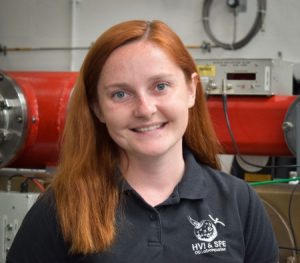
Zoe Emerland

Zoe Emerland

Laboratory Manager, School Of Physical Sciences

Professional biography

I am the HyperVelocity Impact & Space and Planetary Environments Laboratories Supervisor, I focus on the day-to-day running of instruments such as the All-Axis Two-stage Light Gas Gun and the Space and Environment Simulation Chambers. Please contact me if you are interested in using any instruments in the lab for an upcoming project.

Career

2023-Present -  Project Officer - Hypervelocity Impact Laboratory - All-Axis Two-stage Light Gas Gun

2022-2023 - Research Assistant - Hypervelocity Impact Laboratory - All-Axis Two-stage Light Gas Gun

2018-2023 - PhD at the Open University - "An experimental and numerical assessment of ejected martian biosignatures impacting Phobos"

2015-2018 - BSc(Hons) Geology with Planetary Science at the University of Manchester

2013-2015 - A-levels at Hills Road Sixth Form College, Cambridge (Geology, Mathematics, Physics and Chemistry)

Research interests

PhD at the Open University - "An experimental and numerical assessment of ejected martian biosignatures impacting Phobos"

This thesis investigates the delivery of possible martian biosignatures to Phobos and their subsequent detection within the Phobos regolith. iSALE-2D hydrocode was used to investigate the conditions experienced by Mars-like projectiles impacting Phobos-like targets, that were then compared with a survival criteria of shock pressure and temperature for amino acids. The resultant amino acid survivability varied broadly. To validate the numerical simulations, hypervelocity impact experiments were conducted, whereby bespoke Mars-relevant basaltic projectiles doped with the potential organic biosignature glycine, were fired using the All-Axis Light Gas Gun (AALGG) into two Phobos regolith simulants at a range of velocities. The bespoke projectiles fragmented upon acceleration resulting in buckshot cluster impacts where the proportion of glycine that survived impacts at similar velocities varied broadly, regardless of Phobos simulant used. This presented a fundamentally different impact process than would be experienced on Phobos. Therefore, to validate the numerical simulations with an alternative approach, the impact experiment results were compared to numerical simulations on the spatial scale of the AALGG experiments, that focussed on cluster impacts. These simulations revealed that amino acid survival and detection could be significantly affected by how early within a cluster a projectile fragment impacts. Nevertheless, the small-scale numerical simulations aligned well with the impact experiments suggesting it is an adequate tool for estimating the temperatures and pressures in real impactors. Finally, comparing the results from the large-scale numerical simulations with the impact experiments it was revealed that the datasets could be fit by logistic function sigmoid curves with impact velocity.
 

I work closely with the AstrobiologyOU research group - https://twitter.com/Astrobiology_OU


Latest publications

Displaying 10 of 18 publications

  • Krýza, O., Brož, P., Pěnkavová, V., Havlica, J., Zedníková, M., Emerland, Z., Patel, M. and Sylvest, M., 2026, ‘Effect of Unstable Water Flow on Grain Transport: Insights From Laboratory Experiments Under Reduced Atmospheric Pressure’, Journal of Geophysical Research: Planets, 131(6), https://oro.open.ac.uk/110609/.
  • Patočka, V., Brož, P., Chan, K., Biju Sindhu, P., Fox-Powell, M. G., Sylvest, M., Emerland, Z. and Patel, M. R., 2026, ‘Layered bubble-rich structures on icy worlds: near-vacuum experiments with large volumes of low-salinity water’, Earth and Planetary Science Letters, 685, https://oro.open.ac.uk/109731/.
  • Piccirillo, A. M., Della Corte, V., Rotundi, A., Inno, L., Bertini, I., Cozzolino, F., Ferone, A., Fiscale, S., Longobardo, A., Ferretti, S., Ammannito, E., Grappasonni, C., Sindoni, G., Emerland, Z., Sylvest, M., Patel, M., Ertel, H., Millinger, M. and Rothkael, H., 2026, ‘A light dust shield, including aerogel, for DISC instrument on board ESA's Comet Interceptor mission: numerical simulations and Ballistic Limit Equation’, CEAS Space Journal, 18 pp. 145–157., https://oro.open.ac.uk/104946/.
  • Adler, J. B., Rivera-Hernández, F., Thompson, S., Brož, P., Sylvest, M. E., Emerland, Z. S., Patel, M. and Fox-Powell, M., 2025, ‘Microclimate governs the morphology of sediment flows on Mars’, Communications Earth & Environment, 6, https://oro.open.ac.uk/106868/.
  • Emerland, Z. S., 2023, ‘An Experimental and Numerical Assessment of Ejected Martian Biosignatures Impacting Phobos’, [Thesis], https://oro.open.ac.uk/94764/.
  • Emerland, Z., Sylvest, M. and Patel, M., 2023, ‘The Open University Hypervelocity Impact Laboratory: An All-Axis Aeroballistic Range Facility’, in 72nd Aeroballistic Range Association Meeting, 10-15 Sep 2023, Tokyo, Japan., https://oro.open.ac.uk/95867/.
  • Morland, Z., Halim, S., Pearson, V., Patel, M., Green, S. and Ramkissoon, N., 2021, ‘Modelling ejected martian biomarkers impacting Phobos’, in 52nd Lunar and Planetary Science Conference, 15-19 Mar 2020 (Virtual), Houston, USA., https://oro.open.ac.uk/75322/.
  • Morland, Z. S., Pearson, V. K., Patel, M. R., Green, S. F., Ramkissoon, N. K. and Spencer-Jones, C. L., 2020, ‘Characterising the Transfer of Biomarkers within the Phobos-Mars System’, in 51st Lunar and Planetary Science Conference, 16-20 Mar 2020 (Cancelled), Houston, USA., https://oro.open.ac.uk/70807/.
  • Morland, Z., Halim, S., Pearson, V., Patel, M., Green, S. and Ramkissoon, N., 2020, ‘Modelling the survival of ejected martian biomarkers impacting Phobos’, in Europlanet Science Congress 2020, 21 Sep - 9 Oct 2020, Virtual., https://oro.open.ac.uk/71793/.
  • Moreland, Z., 2020, ‘Mars' moon Phobos: A better place to search for Martian life than Mars itself? Postgraduate Research Poster Competition, The Open University’, https://oro.open.ac.uk/71307/.