Meet the people who make up STEM Faculty.

I am a Professor of Planetary Mineralogy in the School of Environment, Earth and Ecosystem Sciences, and a mineralogist by training. I joined the Open University in 2009 for a post doctoral position, became a Research Investment Fellow in 2013, a lecturer in 2015, a senior lecturer in 2017, and a professor in 2024.
My professional journey started with the goal to become a journalist... I decided to study a natural science and settled on mineralogy, which I studied at University of Mainz. During my studies I worked at a German newspaper in parallel, and then decided to pursue a PhD. I graduated from University of Mainz with my PhD in 2004 and held post-doctoral positions in the field of noble gases (Max-Planck Institute for Chemistry, Germany) and impact-cratering (Lunar and Planetary Institute, US), before coming to the OU.
Here at the OU I am associate director of AstrobiologyOU, and the postgraduate tutor in the School of Environment, Earth and Ecosystem Sciences. Internationally, I am part of the NASA Curiosity Rover science team, an interdisciplinary scientist of the ESA Rosalind Franklin Rover mission, of the Mars Sample Return Campaign Science Group (MSCG) and recently also was on the National Academies A strategy for Humans to Mars panel. I serve as an associate editor at Geochemistry, and as the chair of the publications committee of the Meteoritical Society.
My research interests center around two major topics: water rock reactions and noble gases.
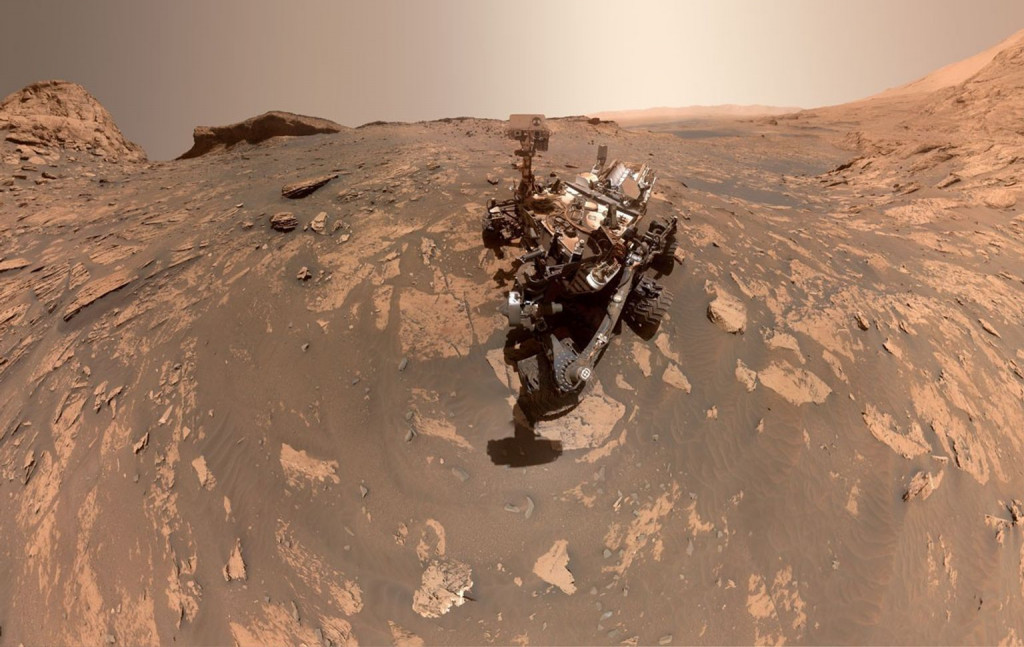
Image above: The Curiosity rover (Selfie at the 'Greenheugh Pediment', NASA image).
The Curiosity Rover at Gale crater is exploring a variety of rocks dominated by mudstones and sandstones, with some conglomerates and other special sedimentary features. Most lately, the rover has entered the sulfate unit, finding more minerals that are indicative of waning water availability. My main interest is in the water-rock reactions that cause diagenesis and alteration throughout the stratigraphic sequence. My work ranges from a general assessment of the diagenetic pathways at Yellowknife Bay - the first part of the sequence investigated by the rover, to working with colleagues ot disentanle details of the evaporation history of the crater, eg. on the detection and pathways of boron at Gale crater, and disentangling surprising and complex findings such as trydimite formation as volcanic or hydrothermal product.
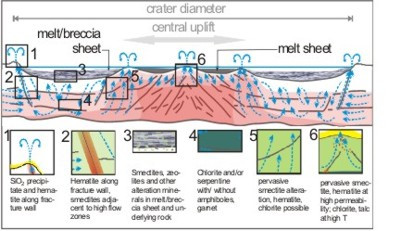
Image above: Impact generated hydrothermal systems (Crater after G. Osinski, water flow after O. Abramov, combined with my modeling
My research on Mars is informed by studying water rock reactions in Martian meteorites and at analog sites. There are two modeling studies that particularly shaped my approach to the Curiosity work - the study of impact generated hydrothermal systems through modeling of the Martian meteorite (LEW88516) composition and the exploration of the effect of host rock diversity as seen in Martian meteories on alteration mineralogy, as well as an in depth study of the nakhlite alteration pathways.
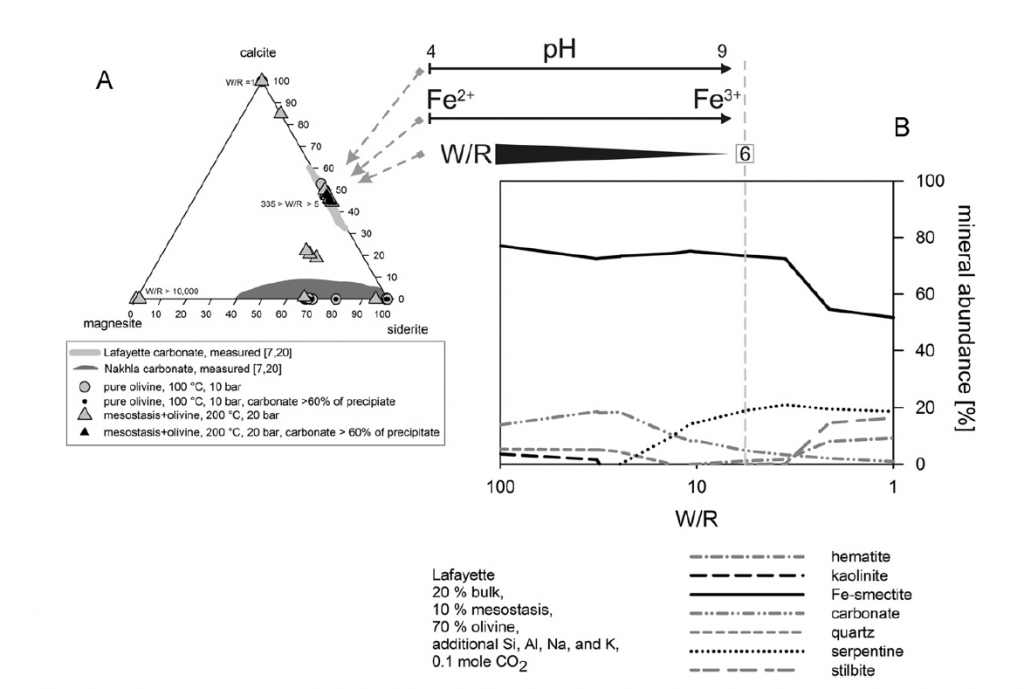
Image above: Model results (Bridges and Schwenzer 2012).
My PhD was on noble gases in Martian meteorites, any my very first research paper on that topic dates back to 2007, and the most recent review appeared in 'Volatiles in the Martian Crust'. This has enabled me to work on topics of the Martian atmosphere and trace gases such as the first detection and the seasonal variation of methane as seen by Curiosity, as well as on age dating of rocks encountered at Gale crater, including late-state alteration. Noble gases also helped in supporting a D/H study disentngling the inhomogneity of the Martian interior.
If not in the lab or in front of a computer to model, my research gets me out into the field to study analog sites, most recently a site in the Utah desert, where we studied a lamprophyre dike for its alteration as well as the implications of such alteration pathways on habitability.
Beyond the research, I am involved in shaping the future of space exploration through participation in white papers, mission simulations, and advisory teams, including Mars Sample Return (see Beaty et al. (2019), MSR Campaign Science Group (2023), Swindle et al. (2022)).
Recent and current teaching commitments include
Before I started my undergraduate studies, I received training and worked as a freelance journalist. Later, I became volunteer editor for a museum (www.lahn-marmor-museum.de) and helped publish two books on science topics for a general audience. With the Mars mission under way and other topics very timely and interesting for school and general audiences, I developed a passion for public outreach. I regulary give talks and presentations, and generally enjoy to share the excitement of exploring Mars and the new insights we gained.
Recently, I have been interviewed for the Space Awareness intiative. It was a lot of fun to talk about how I got into planetary science and what motivates me to continue every day: The video is here. If you want to see the other profiles and find out more: http://www.space-awareness.org/en/ (funded by the EU's Horizon 2020 programme). I have also been interviewed many times about Mars, Mars missions, and my research, here is an example while in the field (Tabernas, Spain) with the ExoFIT team.