Skip to content

Toggle service links

STEM Faculty

Meet the people who make up STEM Faculty.

Simeon Barber

Simeon Barber

Senior Research Fellow

Professional biography

Space missions enable us to explore other worlds...
       ...and along the way we can learn to understand and improve our own.

Moon@OU is a team of scientists and engineers studying our nearest neighbour in space.

In the lab we analyse meteorites and returned samples to unravel the Moon's history.
And we fly miniaturised lab instruments on space missions to study new samples in new places on the Moon.

With international partners we study the water cycle that is happening on the Moon today, driven by hot days and cold nights.
And near the lunar South pole we will identify and quantify water ice and other chemicals that may have accumulated over billions of years.

We call this exploration science. Studying the history and processing of water on the Moon helps us understand the role of this precious substance in our solar system. 
And if we can learn to carefully extract it in useful forms such as hydrogen and oxygen,
it could help humans live and work on the Moon and provide a stepping stone for new, affordable and sustainable missions to Mars.

We use the knoweldge and skills we learn in our space research to create benefits for society on Earth. 

Research interests

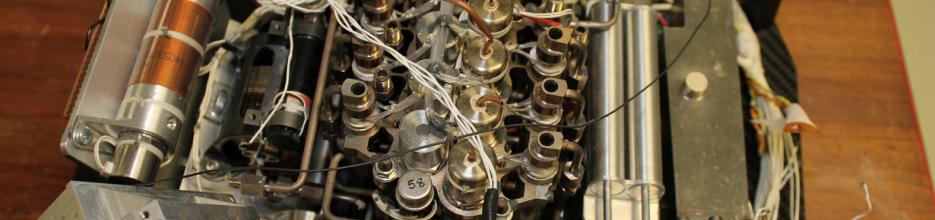
  • PROSPECT / ProSPA:  The OU is leading the development of ProSPA, a miniature chemical laboratory for analysing samples for water and ice at the Moon. It is half of ESA's PROSPECT drilling and analysis package for a NASA CLPS mission which which aims to land near the south pole of the Moon. PROSPECT will carry out a detailed survey of how water and other molecules are distributed on and under the Moon’s surface. It will help us understand where these materials came from, and whether they might be harvested as useful resources. The OU is partnered in UK by RAL Space, Airbus Defence and Space, and Dynamic Imaging Analytics; in Germany we work with Max Planck Institute for Solar System Research and Technical University of Munich. PROSPECT is led by Leonardo S.p.A. (Italy) under a programme of and funded by ESA.
  • Exospheric Mass Spectrometer EMS / PITMS:  PITMS was a payload on Astrobotic Peregrine Mission-1, which aimed to be the first US-built lander on the Moon since Apollo 17. PITMS was designed to study how a lunar water cycle might be driven by the hot daytime and cold night-time temperatures of the Moon’s surface. And how over millions of years this may contribute to vast stores of water and other molecules at permanently cold polar regions – molecules that could tell us the history of our own planet and might support human exploration of the solar system. However, soon after launch on 8 January 2024, the spaceraft developed a fault in its propulsion system. PITMS was therefore redirected to study the gases in and around the spacecraft, and gained valuable data about the instrument performance and lander ennvironment before the mission ended 8 days later with controlled re-entry above the Pacific Ocean.  The instrument was led by Dr Barbara Cohen at NASA Goddard Space Flight Center. The OU, partnered by RAL Space and funded by ESA, developed the Exospheric Mass Spectrometer for PITMS and supported its scientific operations. The science and perofrmance demonstrated by the mission will feed into future flights of related payloads, including ProSPA and EMS-LUPEX (below).
  • Drill-eye:  a miniature camera mounted inside a drill that will allow scientists to see in real-time under the surface of the Moon or Mars. By picturing the inside of a bore-hole in real time, we capture valuable scientific information about sub-surface layering, ice content and partical size, that can be lost when a sample is excavated to the surface for anaysis.  
  • iDrill:  an intrumented drill concept for rapid chemical and physical analysis of the lunar sub-surface 
  • Rosetta:  our gas chromatograph/mass spectrometer "Ptolemy" made the first ever chemical composition measurements on the surface of a comet on 12 Nov 2014 on board the Philae comet lander [UK Space Agency/ESA]
  • Beagle 2 GAP (Gas Analysis Package):  our gas analysis instrument was delivered to Mars on 25 December 2003 by Beagle2 but regrettably the lander failed to fully deploy and operations did not proceed. But all was not in vain; what we learned is being put to use in ProSPA and EMS.