Meet the people who make up STEM Faculty.

Richard is a Senior Lecturer in Materials Engineering in the School of Engineering and Innovation. His work connects materials science, structural integrity, advanced characterisation and architectured materials, with a focus on turning engineering materials problems into measurable, testable and engaging research.
His research is strongly collaborative, bringing together engineers, mathematicians, physicists, designers, computational researchers, national facilities and industrial partners. Across these collaborations, he is particularly interested in the point where fundamental ideas become tools, experiments, demonstrators or methods that can be used in real engineering systems.
Richard studied materials engineering at undergraduate and postgraduate levels and holds a PhD from the University of Manchester, where his research focused on materials and residual stress challenges in the additive manufacturing of aerospace alloys.
Richard’s research centres on understanding how the internal structure, manufacturing history and geometry of materials determine their performance.
One major area of interest is residual stress and structural integrity. Residual stresses are introduced by processes such as welding, additive manufacturing, machining, heat treatment, surface engineering and repair. They can strongly influence fatigue, fracture and component lifetime, with consequences for the safety of many everyday engineering systems. These stresses are often unknown and notoriously difficult to measure and predict.
Richard combines advanced experimental measurement, modelling and materials science to understand residual stresses, their origins and their consequences for material behaviour. His research uses neutron and synchrotron X-ray diffraction at national and international research facilities, alongside mechanical stress-relaxation methods available on the Open University campus in Milton Keynes.
A second major area is aperiodic and architectured materials. Conventional cellular materials and lattice structures commonly use periodic or random arrangements. Richard investigates a third possibility based on aperiodic tilings: structures that possess long-range order without translational periodicity.
Working with mathematicians, engineers and designers, he explores whether aperiodic order can be used as an engineering design principle. This research has demonstrated unusual and desirable combinations of elastic properties, low directional dependence and independent control of properties that are typically strongly coupled in conventional cellular structures.
A third strand concerns materials for extreme environments, particularly nuclear energy systems. His work includes alloy development, residual stress in welded and clad structures, high-temperature materials and the application of advanced characterisation methods to materials degradation and structural integrity.
Richard leads residual stress measurement activities that bring together research expertise and specialist measurement capabilities to solve industrial problems. Through commercially focused work, he has partnered with more than 45 organisations across four continents, including companies in nuclear energy, aerospace, Formula 1, shipping and heavy industry.
He was Principal Investigator of the EPSRC New Horizons project Novel superior materials based on aperiodic tilings, which systematically investigated the mechanical behaviour of deterministic aperiodic metamaterials.
He was also Principal Investigator of the EPSRC UK–India programme Cobalt-free Hard-facing for Reactor Systems, a collaboration between The Open University, the University of Manchester and the Indira Gandhi Centre for Atomic Research in India. The project developed and evaluated alternatives to cobalt-containing alloys used in reactor systems, with the potential to substantially reduce occupational radiation exposure associated with activated cobalt.
Richard contributes to leadership within the EPSRC Nuclear Energy Futures Centre for Doctoral Training and has supervised 14 doctoral researchers across nuclear materials, residual stress, neutron diffraction, additive manufacturing, nickel superalloys, structural integrity and architectured materials. He is a UKCGE Recognised Research Supervisor.
Richard welcomes enquiries about full-time and part-time postgraduate research opportunities in any of these areas.
Richard teaches engineering mathematics, materials engineering, experimental methods and engineering practice across all levels of undergraduate study.
A central theme of his teaching is helping students use mathematics as an engineering tool rather than treating it as a separate abstract subject. He has contributed to the design and delivery of engineering mathematics teaching at multiple levels and is involved in developing approaches that integrate mathematical thinking more directly into the engineering curriculum.
For information on engineering mathematics teaching, visit T194.
Richard is particularly interested in helping students move confidently between physical understanding, mathematical representation, computational analysis and experiment. This can be a particular challenge in distance learning. His teaching addresses it through activities that connect engineering mathematics and modelling with strain measurement, materials behaviour, experimental design and engineering practice.
T367 is a third-level module that connects residual stress measurement and materials performance characterisation with theoretical concepts in structural integrity.
Richard has extensive experience of distance and online engineering education, including the development of practical experimental activities that students can engage with remotely. He also regularly tutors engineering experiments using equipment supplied directly to students through T176 and T276.
His teaching leadership and curriculum development responsibilities have included presentation leadership, external examining, residential school leadership and mentoring colleagues taking on module leadership roles. He is a Senior Fellow of the Higher Education Academy.
Richard’s industrial research has supported measurement programmes, structural integrity assessments and the development of new analytical methods for organisations including Rolls-Royce, EDF Energy and motorsport teams. Projects have addressed residual stress in welds, coatings, additive manufacturing processes and complex engineering components. This work has also translated research into an AI-based tool to support structural integrity assessment.
Richard is active in public engagement and has given invited talks to academic, industrial and public audiences in the UK and internationally. He has contributed to science festivals, mathematics events, school outreach and public lectures.
His aperiodic materials research is particularly suited to engagement across science, engineering, mathematics, art and design. Physical demonstrators and visualisations serve both as research tools and as ways to introduce broader audiences to the idea that order does not require repetition.
External collaborations
Richard’s research involves longstanding collaborations with universities, national laboratories, international research facilities and industrial organisations.
His work has involved major international facilities, including:
His research collaborations have included academic, national laboratory and industrial partners in the United Kingdom, United States, Mexico, Sweden, Japan, India and South Korea.
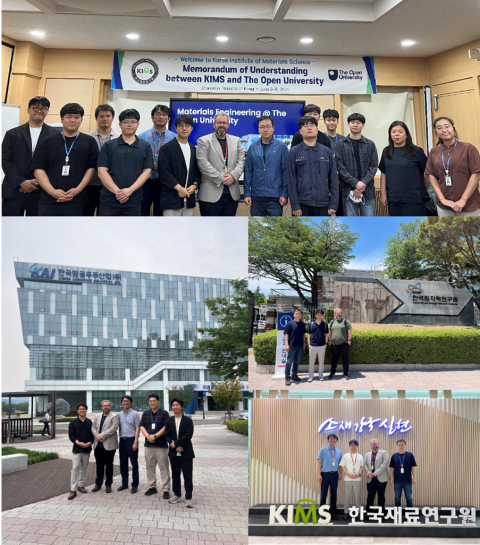
He has given invited research talks internationally, including at the University of California, Berkeley, the Korea Institute of Materials Science and Cinvestav in Mexico.
Displaying 10 of 57 publications