Meet the people who make up STEM Faculty.

I am a palaeoceanographer and foraminiferal micropalaeontologist. My research focuses on using the superb archive of marine plankton microfossils (foraminifera) contained in deep-seafloor sediments to tackle questions about how carbon cycles through the oceans, how oceans operated in past warm climates, and the role of climatic change in structuring ocean ecosystems and evolution. The foraminifer microfossil record is unparalleled, on land and sea, in its temporal resolution, continuity, chronological precision, spatial coverage, and ease with which biotic time series and palaeo-environmental reconstructions can be integrated. My work spans the disparate fields of the palaeoceanography of the very warm Eocene and the cold Pleistocene epochs, but with a unifying emphasis on understanding links between climatic variability, carbon cycling, and the biosphere in both end-member climate states.
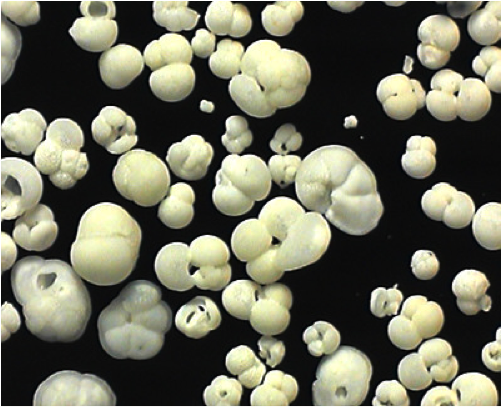
A fossil assemblage of different planktonic foraminifer species from recent deep-sea sediments. The foraminifer tests vary from 250 to 600 microns in diameter.
• palaeoceanography and carbon cycling of past warm 'greenhouse' climates
• interactions between ocean circulation, ocean carbonate chemistry and atmospheric CO2
• role of climatic change in structuring ocean ecosystems and evolution
Across each of these research themes, I use high precision calibration of geological time from Earth’s astronomical cycles to evaluate rates of change with great temporal precision. I employ a multidisciplinary approach (using an array of geochemical ‘proxies’ and micropalaeontological methods) and work closely with climate/geochemical modellers. Model simulations add value to the observational proxy-based reconstructions by providing a global reconstruction to accompany spatially sparse observational data and by evaluating the competing influence of different processes in interpreting the data.
I have worked extensively with the International Ocean Discovery Program (IODP), having participated in two expeditions as Sedimentologist for Leg 207 and Micropalaeontologist for Exp. 342. I helped develop Exp. 342 (to the Newfoundland margin) from its inception (participating in its preliminary 2004 site survey expedition), through its proposal stage (co-authoring the IODP proposal 661) to its successful completion.
My research examines how past extreme global warming events (analogous to our current global warming) changed how carbon cycled within the ocean’s interior and impacted ocean acidification and ocean carbonate saturation, providing new insights into the ocean’s likely response to ongoing global warming. I have focussed on exposing the dynamics of carbon cycling across rapid climatic warming events (‘hyperthermals’) within the Eocene extreme ‘greenhouse’. I have offered an alternative explanation for their genesis involving internal redistribution of oceanic carbon, in contrast to prevailing views that invoked repeated releases of carbon from buried sedimentary reservoirs.
The figure below shows 3 sources of carbon that should produce perturbations to oceanic d13C and pCO2 with different size, shape, duration & recovery trends. The record of d13C across hyperthermals allows us to diagnose which of these 3 carbon sources is most likely to have driven the observed hyperthermal.

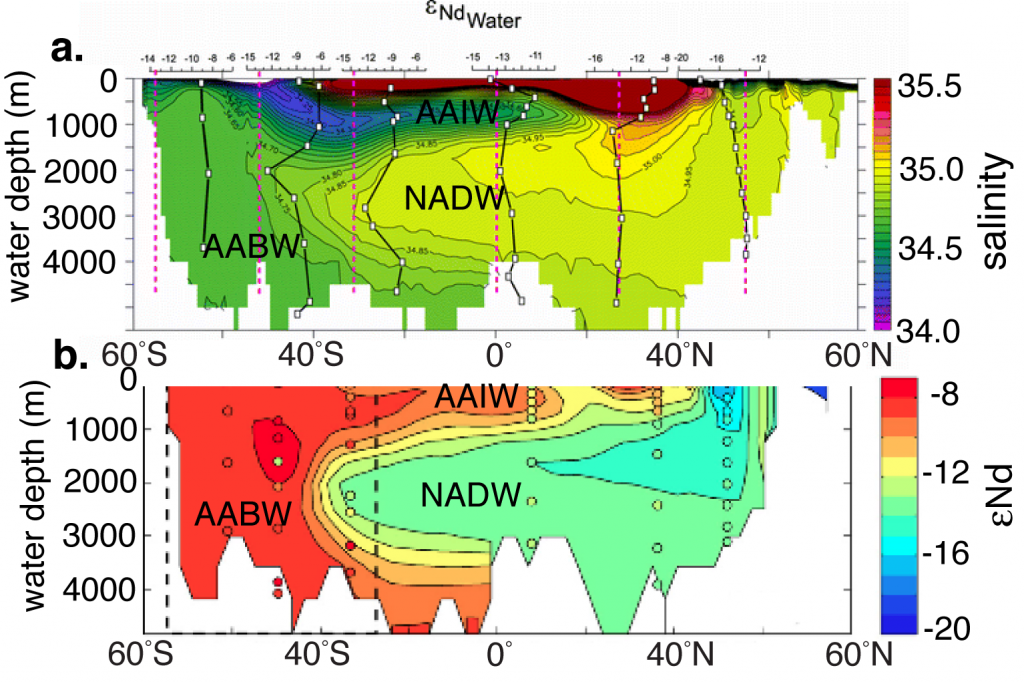
My group are using paired analyses of neodymium isotopes and benthic foraminifer carbon isotopes to reconstruct water mass flow pathways and ventilation state during the Eocene greenhouse. The aim is to determine how the Atlantic overturning circulation during extreme warmth may have differed from its modern counterpart, and its role in driving Eocene climatic change at orbital to secular timescales.
The top panel in the figure below shows the well-constrained tripartite structure of Atlantic water masses based on salinity measurements, while the lower panel shows that this same tripartite water mass structure is seen from Nd isotope data across the same Atlantic transect. This shows that Nd isotope data record the principal features of the bipolar modern Atlantic Ocean circulation, underscoring their potential to reconstruct the bipolar nature of circulation in the geological past (figure modified after von Blanckenburg, (1999)).
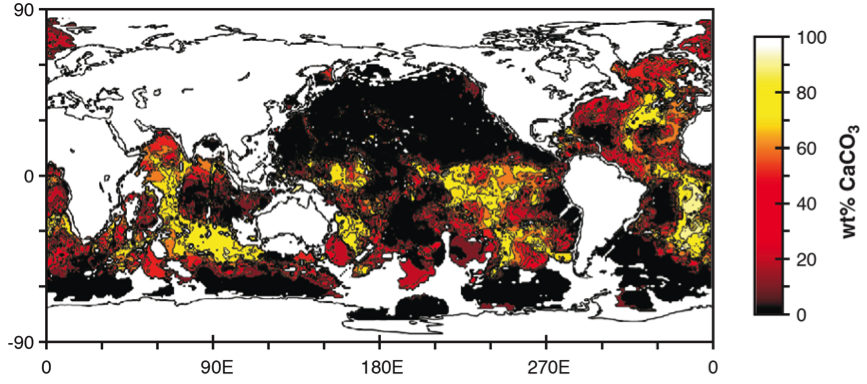
I am also pursing work on how changes in ocean circulation regulate dissolved inorganic carbon storage, calcium carbonate saturation and the implications for changes in atmospheric CO2 levels across climate cycles, in both the warm Eocene and cold Pleistocene epochs. In palaeoceanography, a question remaining unanswered for >50 years was why the Atlantic and Pacific have an anti-correlation in their sedimentary carbonate cycles. My work has revealed that this anti-correlated carbon cycle behaviour between the two main ocean basins originated 1.2 million years ago, coincident with a major global climate shift and decrease in atmospheric CO2 levels.
Distribution of the calcium carbonate content of the surface sediments of the deep sea (Archer, 1996).
Predicting the sensitivity of marine ecosystems and plankton biogeography to global change, and their vulnerability to extinction, is currently beset with uncertainty because the relevant ecological and biogeochemical processes operate and interact in the considerable temporal and intellectual gap between the classic fields of ecology/biogeochemistry vs. geology/palaeoceanography. My work aims to bridge this gap.
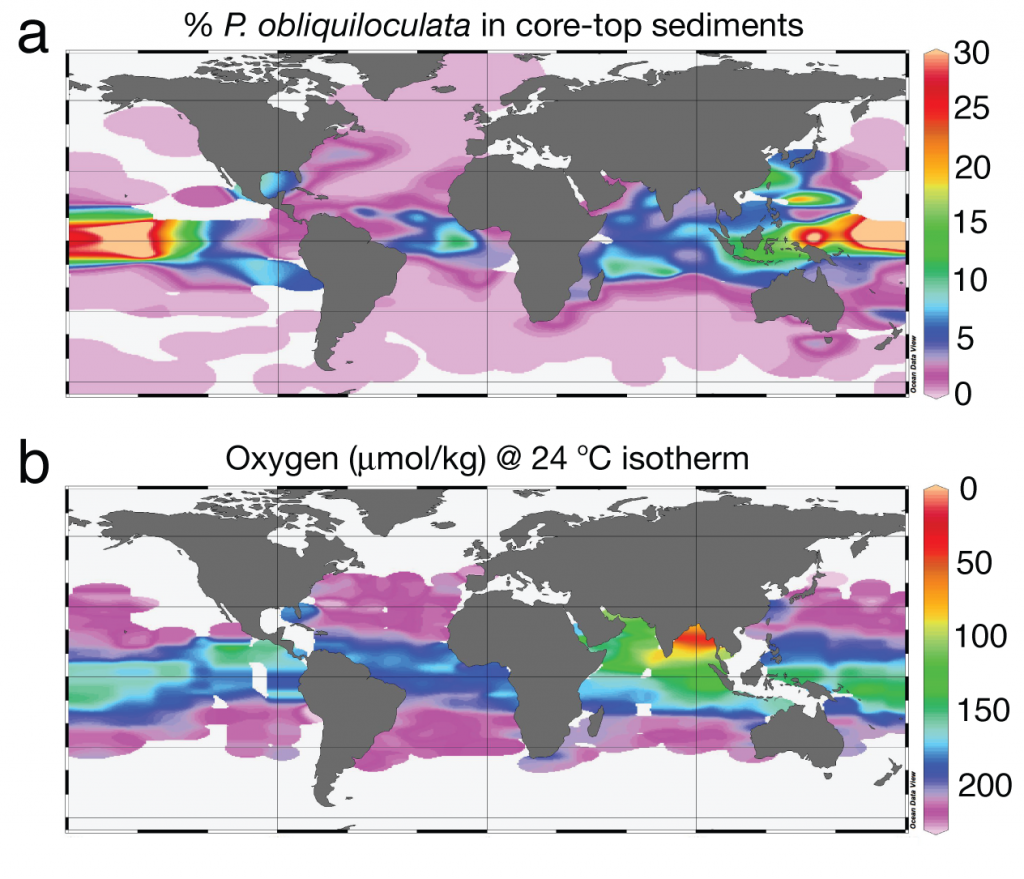
I am investigating the impact of the ocean’s overturning circulation on plankton populations. This has led to a mechanistic oceanographic explanation for one of the earliest discoveries in palaeoceanography – the observation in 1935 that a well-known species of tropical plankton disappeared from the Atlantic Ocean during each ice age. Contrary to prevailing hypotheses, these plankton disappearances arose from a tropical thermocline that was better oxygenated during ice ages than it is today. These findings also revealed that population dynamics of plankton across the vast lower latitude oceans are regulated by water mass formation in relatively small areas of the high latitudes that oxygenate the lower latitude thermocline.
I am also exploring the role of ocean circulation in modulating inter-ocean exchanges of plankton populations. Plankton are able to freely disperse long distances, enabling them to opportunistically colonise normally inhospitable environments as soon as they become favourable. This ran counter to the long-standing view that the ocean possessed tectonic and water mass ‘barriers’ to plankton dispersal.
Figure showing how modern global distributions of the upper thermocline-dwelling foraminifer P. obliquiloculata closely track seawater oxygen concentrations across the isotherm along which this species resides.
PhD projects are largely funded through the CENTA Doctoral Training Programme and are also advertised on the PhD page of our department website. Projects are typically posted in October with a January deadline. I'm also happy to help motivated candidates pursue other funding sources, or discuss specific project ideas.
Several competitive fellowships exist in the UK for postdoctoral scholars, including NERC IRF, The Leverhulme Trust, Royal Society URF, Royal Society Newton, Royal Society Dorothy Hodgkin, Marie Curie and the Royal Commission for the Exhibition of 1851. If you're interested in applying for one of these to work together at The Open University please get in touch and I'll be happy to discuss ideas and help you develop a proposal.
Bokhari-Friberg, Y., Anand, P., Romero, O.E., Littler, K., Robinson, M.M., Sexton, P.F., Leng, M.J. and Murayama, M. (2025). Influence of Indian Summer Monsoon on Marine Biological Productivity Across the Late Pliocene and Early Pleistocene, Paleoceanography and Paleoclimatology, 40(7), e2024PA004995.
Kirtland-Turner, S., Ridgwell, A. Keller, A., Vahlenkamp, M., Aleksinksi, A., Sexton, P.F., Penman, D., Hull, P., and Norris, R.D. (2024). Sensitivity of ocean circulation to warming during the Early Eocene greenhouse, Proceedings of the National Academy of Sciences, 121, e2311980121.
Moretti, S., Auderset, A. Deutsch, C., Schmitz, R., Gerber, L., Thomas, E., Luciani, V., Petrizzo, M.R., Schiebel, R., Tripati, A., Sexton, P.F., Norris, R., D’Onofrio, R., Zachos, J., Sigman, D.M., Haug, G.H. and Martínez-García, A. (2024). Oxygen rise in the tropical upper ocean during the Paleocene-Eocene Thermal Maximum, Science, 383,727-731.
van der Ploeg, R., Cramwinckel, M.J., Kocken, I.J., Leutert, T.J., Bohaty, S.M., Fokkema, C.D., Hull, P.M., Meckler, A.N., Middelburg, J.J., Müller, I.A., Penman, D.E., Peterse, F., Reichart, G-J., Sexton, P.F., Vahlenkamp, M., De Vleeschouwer, D., Wilson, P.A., Ziegler, M. and Sluijs, A. (2023). North Atlantic surface ocean warming and salinization in response to middle Eocene greenhouse warming, Science Advances, 9, eabq0110.
Woodhouse, A.D., Procter, F.A., Jackson, S.L., Jamieson, R.A., Newton, R.J., Sexton, P.F. and Aze, T. (2023). Paleoecology and evolutionary response of planktonic foraminifera to the mid-Pliocene Warm Period and Plio-Pleistocene bipolar ice sheet expansion, Biogeosciences, 20, 121–139.
Meckler, A., Sexton, P.F., Piasecki, A., Leutert, T., Marquardt, J., Ziegler, M., Agterhuis, T., Lourens, L., Rae, J., Barnet, J., Tripati, A., and Bernasconi, S.M. (2022). Cenozoic evolution of deep ocean temperature from clumped isotope thermometry, Science, 377 (6601), 86-90.
Zhang, Y., de Boer, A.M., Lunt, D.J., Hutchinson, D.K., Ross, P., van de Flierdt, T., Sexton, P.F., Coxall, H.K., Steinig, S., Ladant, J-P., Zhu, J., Donnadieu, Y., Zhang, Z., Chan, W-L., Abe-Ouchi, A., Niezgodzki, I., Lohmann, G., Knorr, G., Poulsen, C.J., Huber, M. (2022). Early Eocene ocean meridional overturning circulation: the roles of atmospheric forcing and strait geometry, Paleoceanography and Paleoclimatology, 37, e2021PA004329.
Nilsson-Kerr, K., Anand, P., Sexton, P.F., Leng, M.J. and Naidu, D. (2022). Indian Summer Monsoon variability 140-70 thousand years ago based on multi-proxy records from the Bay of Bengal, Quaternary Science Reviews, 279, 107403.
Woodhouse, A.D., Jackson, S.L., Jamieson, R.A., Newton, R.J., Sexton, P.F. and Aze, T. (2021). Adaptive ecological niche migration does not negate extinction susceptibility, Nature Scientific Reports, 11, 15411.
Anagnostou, E., John, E.H., Babila, T.L., Sexton, P.F., Ridgwell, A., Lunt, D.J., Pearson, P.N., Pancost, R.D., Foster, G.L. (2020). Proxy evidence for state-dependence of climate sensitivity in the Eocene greenhouse, Nature Communications, 11, 4436.
Hull, P.M., Bornemann, A., Penman, D., Henehan, M.J., Norris, R.D., Wilson, P.A., Blum, P., Alegret, L., Batenburg, S., Bown, P.R., Bralower, T.J., Cournede, C., Deutsch, A., Donner, B., Friedrich, O., Jehle, S., Kim, H., Kroon, D., Lippert, P., Loroch, D., Moebius, I., Moriya, K., Peppe, D.J., Ravizza, G.E., Röhl, U., Schueth, J.D., Sepúlveda, J., Sexton, P.F., Sibert, E., Śliwińska, K.K., Summons, R.E., Thomas, E., Westerhold, T., Whiteside, J.H., Yamaguchi, T. and Zachos, J.C. (2020). On impact and volcanism across the Cretaceous-Paleogene boundary, Science, 367, 266-272.
Leutert, T., Sexton, P.F., Tripati, A., Piasecki, A., Ling Ho, S. and Meckler, A. (2019). Sensitivity of clumped isotope temperatures in fossil benthic and planktic foraminifera to diagenetic alteration, Geochimica et Cosmochimica Acta, 257, 354-372.
Remmelzwaal, S., Dixon, S., Parkinson, I., Schmidt, D., Monteiro, F., Sexton, P.F., Fehr, M., Peacock, C. and James, R. (2019). Investigating ocean deoxygenation during the PETM through the Cr isotopic signature of foraminifera, Paleoceanography and Paleoclimatology, 34. https://doi.org/10.1029/2018PA003372.
Kerr, K., Anand, P., Sexton, P.F., Leng, M.J., Misra, S., Clemens, S. and Hammond, S. (2019). Role of Asian summer monsoon subsystems in the inter-hemispheric progression of deglaciation, Nature Geoscience, 12, 290–295.
Badger M.P.S., Chalk T.B., Foster G.L., Bown, P., Gibbs, S., Sexton, P.F., Schmidt, D., Pälike, H., Mackensen, A. and Pancost R.D. (2019). Insensitivity of alkenone carbon isotopes to atmospheric CO2 at low to moderate CO2 levels, Climate of the Past, 15, 539-554.
Boulila, S., Vahlenkamp, M., De Vleeschouwer, D., Laskar, J., Yamamoto, Y., Pälike, H., Kirtland-Turner, S., Sexton, P.F., Westerhold, T. and Röhl, U. (2018), Towards a robust and consistent middle Eocene astronomical timescale, Earth and Planetary Science Letters, 486, 94–107.
Vahlenkamp, M., Niezgodzki, I., De Vleeschouwer, D., Bickert, T., Harper, D., Kirtland-Turner, S., Lohmann, G., Sexton, P.F., Zachos, J. and Pälike, H. (2018). Astronomically paced changes in overturning circulation in the Western North Atlantic during the middle Eocene, Earth and Planetary Science Letters, 484, 329-340.
Batenburg, S.J., Friedrich, O. Moriya, K., Voigt, S., Cournède, C., Möbius, I., Blum, P., Bornemann, A., Fiebig, J., Hasegawa, T., Hull, P., Norris, R., Röhl, U., Sexton, P.F., Westerhold, T., Wilson, P. and the IODP Expedition 342 Scientists (2018), Late Maastrichtian carbon isotope stratigraphy and cyclostratigraphy of the Newfoundland Margin (Site U1403, IODP Expedition 342), Newsletters on Stratigraphy, 51, 245-260. doi:10.1127/nos/2017/0398.
Chalk, T.B., Hain, M.P., Foster, G.L., Rohling, E.J., Sexton, P.F., Badger, M.P.S., Cherry, S.G., Hasenfratz, A.P., Haug, G.H., Jaccard, S.L., Martínez-García, A., Pälike, H., Pancost, R.D. and Wilson, P.A. (2017), Causes of ice-age intensification across the Mid-Pleistocene Transition, Proceedings of the National Academy of Sciences, 114, 13114-13119.
Dyson, M. and Sexton, P.F. (2017). Blue Planet academic consultants: the message humanity cannot afford to ignore, The Conversation, https://theconversation.com/blue-planet-academic-consultants-the-message-humanity-cannot-afford-to-ignore-86157.
Gutjahr, M., Ridgwell, A., Sexton, P.F., Anagnostou, E., Pearson, P.N., Pälike, H., Norris, R.D., Thomas, E. and Foster, G.L. (2017), Very large release of mostly volcanic carbon during the Palaeocene-Eocene Thermal Maximum, Nature, 548, 573-577.
Gutjahr, M., Foster, G.L. and Sexton, P.F. (2017). Volcanic emissions caused the warmest period in past 56m years, The Conversation, https://theconversation.com/volcanic- emissions-caused-the-warmest-period-in-past-56m-years-new-study-82354.
Boyle, P.R., Romans, B.W., Tucholke, B.E., Norris, R., Swift, S.A. & Sexton, P.F. (2017), Cenozoic North Atlantic deep circulation history recorded in contourite drifts, offshore Newfoundland, Canada, Marine Geology, 385, 185-203.
Hull, P.M., Bohaty, S.M., Cameron, A., Coxall, H.K., D’haenens, S., De Vleeschouwer, D., Elder, L.E., Friedrich, O., Kerr, K., Turner, S.K., Kordesch, W.E.C., Moriya, K., Norris, R.N., Opdyke, B.N., Penman, D.E., Pälike, H., Wilson, P.A., Sexton, P.F., Vahlenkamp, M., Wu, F., and Zachos, J.C. (2017). Data report: coarse fraction record for the Eocene megasplice at IODP Sites U1406, U1408, U1409, and U1411. In Norris, R.D., Wilson, P.A, Blum, P., and the Expedition 342 Scientists, Proceedings of the Integrated Ocean Drilling Program, 342: College Station, TX (Integrated Ocean Drilling Program), doi:10.2204/iodp.proc.342.203.2017.
Penman, D.E., Kirtland-Turner, S., Sexton, P.F., Norris, R., Dickson, A., Boulila, S., Ridgwell, A., Zeebe, R., Zachos, J., Cameron, A., Westerhold, T. and Röhl, U. (2016), A carbonate compensation depth overshoot in the aftermath of the Palaeocene-Eocene Thermal Maximum, Nature Geoscience, 9, 575–580.
Salmon, K.H., Anand, P., Sexton, P.F. & Conte, M. (2016), Calcification and growth processes in planktonic foraminifera complicate the use of B/Ca and U/Ca as carbonate chemistry proxies, Earth and Planetary Science Letters, 449, 372-381.
Möbius, I., Friedrich, O., Edgar, K.M. & Sexton, P.F. (2015), Episodes of intensified biological productivity in the subtropical Atlantic Ocean during the termination of the Middle Eocene Climatic Optimum, Paleoceanography, 30, 1041-1058.
Martinez-Botí, M.A., Foster, G.L., Chalk, T. B., Rohling, E.J., Sexton, P.F., Lunt, D.J., Pancost, R.D., Badger, M.P.S. & Schmidt, D.N. (2015), Plio-Pleistocene climate sensitivity evaluated using high-resolution CO2 records, Nature, 518, 49–54.
Salmon, K.H., Anand, P., Sexton, P.F. & Conte, M. (2015), Upper ocean mixing controls the seasonality of planktonic foraminifer fluxes and associated strength of the carbonate pump in the oligotrophic North Atlantic, Biogeosciences, 12, 223-235.
Friedrich, O., Norris, R. D., Wilson, P. A., Opdyke, B. N., Badger, M., Bailey, I., Beddow-Twigg, H., Bohaty, S., Bolton, C., Bornemann, A., Crocker, A., Grützner, J., Herbert, T., Holbourn, A., Hull, P., Liebrand, D., Lippert, P., Lourens, L., Lyle, M., Pross, J., Rosenthal, Y., Sexton, P.F., Stärz, M., & Westerhold, T. (2015). Newfoundland Neogene sediment drifts - Transition from the Paleogene greenhouse to the modern icehouse, Scientific Drilling, 19, 39-42.
Foster, G.L. and Sexton, P.F. (2014), Enhanced carbon dioxide outgassing from the equatorial Atlantic during the last glacial, Geology, 42, 1003–1006.
Kirtland-Turner, S., Sexton, P.F., Charles, C. & Norris, R. (2014), Persistence of carbon release events through the peak of early Eocene global warmth, Nature Geoscience, 7, 748–751.
Kemp, D.B. and Sexton, P.F. (2014), Timescale uncertainty of abrupt events in the geologic record arising from unsteady sedimentation, Geology, 42, 891–894.
Expedition 342 Scientists (incl. Sexton, P.F.) (2014). Paleogene Newfoundland Sediment Drifts, Proc. IODP, 342: College Station, TX (Integrated Ocean Drilling Program), doi:10.2204/iodp.proc.342.2014.
Hohbein, M., Sexton, P.F. and Cartwright, J. (2013), Onset of North Atlantic Deep Water production coincident with inception of the Cenozoic global cooling trend: Reply, Geology, 41, p. e292, doi:10.1130/G34655Y.1.
Edgar, K.M., Bohaty, S.M., Gibbs, S.J., Sexton, P.F., Norris, R.D. and Wilson, P.A. (2013), Symbiont ‘bleaching’ in planktic foraminifera during the Middle Eocene Climatic Optimum, Geology, 41, 15-18.
Sexton, P.F., Wilson, P.A., Bown, P.R. and Liebrand, D. (2013) Expedition 342: Paleogene Newfoundland Sediment Drifts, Integrated Ocean Drilling Program UK Newsletter, 38, 2-7.
Sexton, P.F. and Barker, S. (2012), Onset of 'Pacific-style' deep-sea sedimentary carbonate cycles at the mid-Pleistocene transition, Earth and Planetary Science Letters, 321, 81-94.
Hohbein, M., Sexton, P.F. and Cartwright, J. (2012), Onset of North Atlantic Deep Water production coincident with inception of the Cenozoic global cooling trend, Geology, 40, 255-258.
Expedition 342 Scientists (incl. Sexton, P.F.) (2012). Paleogene Newfoundland sediment drifts. IODP Prel. Rept., 342. doi:10.2204/iodp.pr.342.2012.
Sexton, P.F. and Norris, R.D. (2011), High latitude regulation of low latitude thermocline ventilation and planktic foraminifer populations across glacial-interglacial cycles, Earth and Planetary Science Letters, 311, 69-81.
Sexton, P.F., Norris, R.D., Wilson, P.A., Pälike, H., Westerhold, T., Röhl, U., Bolton, C. and Gibbs, S. (2011), Eocene global warming events driven by ventilation of oceanic dissolved organic carbon, Nature, 471, 349-352.
Edgar, K.M., Wilson, P.A., Sexton, P.F., Gibbs, S.J., Roberts, A.P. and Norris, R.D. (2010), New biostratigraphic, magnetostratigraphic and isotopic insights into the Middle Eocene Climatic Optimum in low latitudes, Palaeogeography, Palaeoclimatology, Palaeoecology, 297, 670-682.
Sexton, P.F. and Wilson, P.A. (2009), Preservation of benthic foraminifera and reliability of deep-sea temperature records: The importance of sedimentation rates, lithology and the need to examine test wall structure, Paleoceanography, 24, PA2208, doi:10.1029/2008PA001650.
Sexton, P.F. and Norris, R.D. (2008), Dispersal and biogeography of marine plankton: Long-distance dispersal of the foraminifer Truncorotalia truncatulinoides, Geology, 36, 899-902.
Edgar, K.M., Wilson, P.A., Sexton, P.F. and Suganuma, Y. (2007), No extreme bipolar glaciation during the main Eocene calcite compensation shift, Nature, 448, 908-911.
Coxall, H.K., Wilson, P.A., Pearson, P.N. and Sexton, P.F. (2007), Iterative evolution of digitate planktonic foraminifera, Paleobiology, 33(4), 495-516.
Sexton, P.F., Wilson, P.A. and Pearson, P.N. (2006), Microstructural and geochemical perspectives on planktic foraminiferal preservation: 'Glassy' versus 'Frosty', Geochem. Geophys. Geosyst., 7, Q12P19, doi:10.1029/2006GC001291.
Sexton, P.F., Wilson, P.A. and Norris, R.D. (2006), Testing the Cenozoic multi-site composite d18O and d13C curves: New mono-specific Eocene records from a single locality, Demerara Rise (Ocean Drilling Program Leg 207), Paleoceanography, 21, PA2019, doi:10.1029/2005PA001253.
Sexton, P.F., Wilson, P.A. and Pearson, P.N. (2006), Palaeoecology of late middle Eocene planktic foraminifera and evolutionary implications, Marine Micropaleontology, 60, 1-16.
Danelian T, Le Callonnec L, Erbacher J et al. (incl. Sexton P.F.), (2005), Preliminary results on Cretaceous-Cenozoic tropical Atlantic pelagic sedimentation (Demerara Rise, ODP Leg 207), Comptes Rendus Geoscience, 337 (6), 609-616.
Erbacher, J., Mosher, D., Malone, M. and ODP Leg 207 Scientific Party (incl. Sexton, P.F.) (2004), Drilling probes past carbon cycle perturbations on Demerara Rise, Eos (Trans. AGU), 85, 57-63.
Sexton, P.F., Thurow, J. and Wilson, P.A. (2003), ODP Leg 207: Demerara Rise - Equatorial Cretaceous and Palaeogene palaeoceanographic transect, UK ODP Newsletter, 29, 18-21.
Sexton, P.F. and Norris, R.D. (2002), Orbital control of late Pliocene planktic foraminiferal biogeography, Newsletter of Micropalaeontology, 66, 18-19.
At The Open University (the world-leader in distance teaching):
S330 Oceanography (30 credits) 2014-present, module team Chair. 2010-2014, module team member.
S366 Evolution (30 credits) 2010-2015, module team member, responsible for Macroevolution and Palaeontology (~ one third of module)
S175 Frozen Planet (10 credits) 2013-present, module team Chair
SXG288 Practical Science: Earth and Environment (30 credits) 2013-2014, module team Chair
S104 Exploring Science (60 credits) 2013-2014, module team member, responsible for Earth Science
S209 Earth Science (60 credits) 2014-present, module team member, responsible for Palaeontology, and Sedimentary Processes/Environments (~40% of module)
S309 Earth System Processes (60 credits) 2014-present, production module team member, responsible for the Oceans block (3 of 6)
I served as Academic Consultant for the landmark BBC-Open University co-produced 7-part TV series ‘Blue Planet II’ exploring the natural history and health of our oceans. These were the most watched TV programmes of 2017, attracting 37 million viewers. My research has had other impacts beyond academia, including the production of a Blue Planet II-oriented poster for the public with research-level scientific information about our oceans’ health for which 590,000 copies were sent out on request, and a series of public talks around the UK. I have developed interactive online learning resources that form bridges between Blue Planet II and the OU curriculum, thereby facilitating the journey from informal to formal learning. These have utilised diverse approaches and methodologies, including gaming technology (‘Ocean Explorer’), and 3D ‘immersive’ visualisations of complex ocean processes to form five Virtual Oceanographic Field Trips.