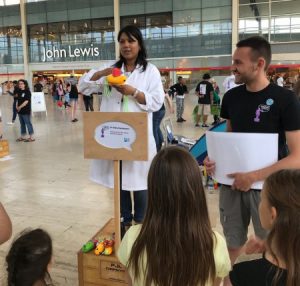
Meet the people who make up STEM Faculty.

I am a planetary scientist working in the interdisciplinary field of astrobiology. My research uses laboratory experiments and modelling to explore how various processes, such as hypervelocity impacts, hydrothermal processes, and biological activity, can influence the evolution of planetary bodies within the Solar System. My current research focuses on determining if geochemical signatures generated via microbe-silicate interactions could be detected by space missions, and if these signatures could be used to determine if microbes have ever existed on potentially habitable bodies, such as Mars and Europa.
I have specific expertise in the effects of hypervelocity impacts on Mars via two processes: serpentinisation and devolatilisation. These two (potentially) impact-induced processes have the potential to effect the composition of the martian atmosphere, by either the production of methane (via serpentinisation) and the release of volatiles. My PhD (University of Kent) examined the possibility of indirectly detecting these processes using Raman spectroscopy.
My research focuses on the changes that can occur to minerals as a result of biological life. These changes can act as bio-signatures that can be used to identify life, past or present, on planets such as Mars.
I also investigate mineralogical changes that occur in high pressure and temperature environments arising from meteorite impacts on planetary bodies, which results in alteration to the crust of rocky bodies (such as Mars), potential alteration to atmosphere composition (thus effecting the climates of these bodies) and the potential for these impact craters to support life.
As part of my research I have gained experience in a number of analytical techniques, such as Raman spectroscopy, SEM-EDS analysis, electron microprobe, thermogravimetric analysis and differential scanning colorimetry. I have also conducted computer modelling to examine the physical conditions experienced in hypervelocity impacts and thermochemical changes that occur as a result of water-rock interactions.