Meet the people who make up STEM Faculty.

I am a Senior Lecturer in the School of Physical Sciences. As a theoretical physicst I have interests in quantum materials (especially superconductors), quantum simulators and biophysics / mathematical biology. Prior to joining the Open University I carried out postdoctoral research in Germany, the USA and the UK. I gained a physics degree (MPhys) from the University of Oxford, UK, followed by a PhD in theoretical physics from the University of Warwick. I have close links to the School of Life Health and Chemical Sciences, the School of Mathematics and Statistics, the School of Computing and Communications and the Knowledge Media Institute.
I have a wide variety of research interests centred around theoretical physics and applied maths. My main acitivity is the development of new models and methods, especially the development of Monte Carlo techniques. The current themes of my main research activity are in the following areas:
Biophysics / Mathematical Biology - Cardiovascular systems and diseases. Models of living tissues.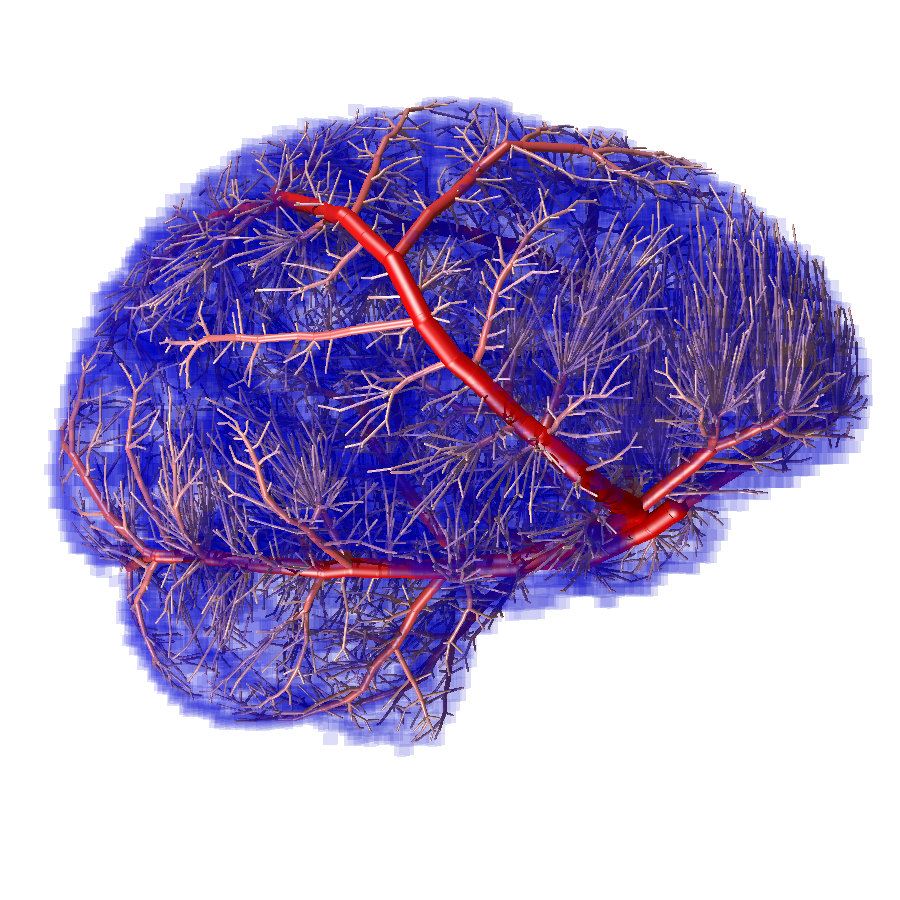
Cultured tissues are growing in importance and have applications in pharmaceutical testing, regenerative medicine and cultured meat. My research uses physics to understand and predict the self-organisation of key components of tissues - the cells, blood vessels (vasculature) and extra-cellular matrix (the material that sits around cells and gives tissue its structure). I develop new models and techniques for predicting the structures of vasculatures and self-organisation in tissues due to interactions between cells and the extracellular matrix. I also develop mathematical models for the simulation of embolic stroke. Follow these links to my articles in The Conversation, or find out about the work of the Biophysics Group.
Theory of Quantum Materials - Superconductivity and graphene, especially models involving electron-phonon interactions and strong correlation.
Interactions between electrons in quantum materials lead to important phenomena such as superconductivity and magnetism. I am particularly interested in unconventional superconductivity, and the interplay between strong electronic correlations and electron-phonon interactions (the interactions between electrons and lattice vibrations). I research the role of electron-phonon interactions in quantum materials, especially where they are found in close proximity to strong correlation. This includes the development of quantum Monte Carlo techniques and the use of perturbative and exact diagonalisation techniques. I am particularly interested in systems where the electron-phonon interaction is too strong for low order perterbative techniques.
Follow this link to the Theory of Condensed Matter Group.
Theory of Quantum Simulators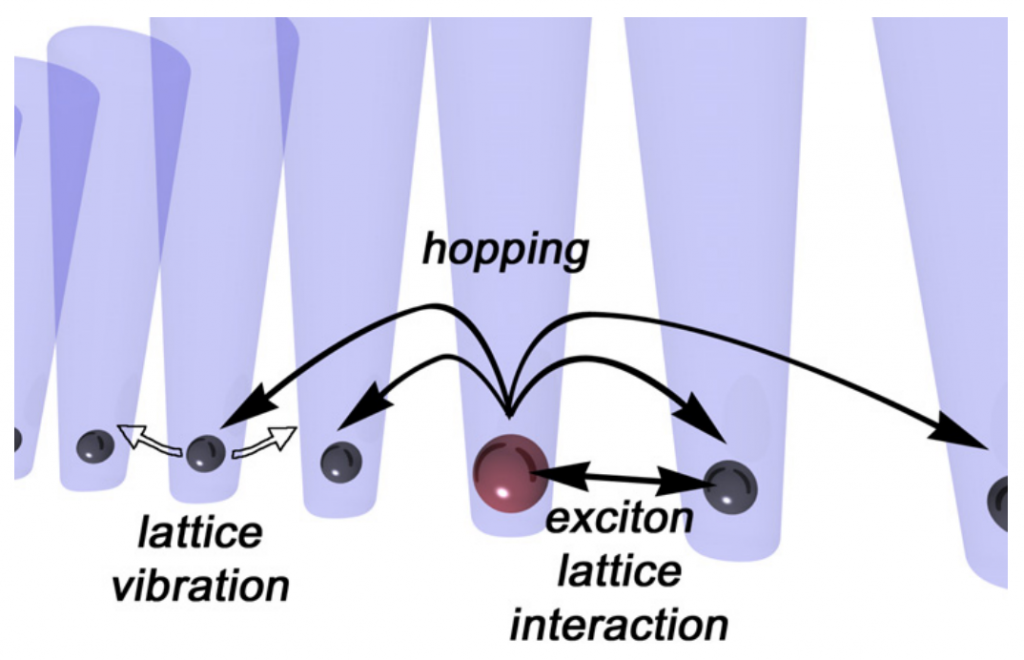
Quantum simulators built using optical lattices and arrays of optical tweezers have a growing role for understanding quantum materials. A quantum simulator is a kind of analogue quantum computer that emulates the complex interactions in quantum materials. Optical lattices are formed use lasers to make regular grids representing materials. I research how strong correlation and electron-phonon interactions can be emulated in quantum simulators. This has led to novel proposals for quantum simulators of electron-phonon interactions using Rydberg atoms placed in lattices formed using arrays of optical tweezers.
Follow this link to the Theory of Condensed Matter Group.
I have produced material for a wide range of Open University modules on: special and general relativity (Stage 3), quantum physics (Stages 1,2,3,4), classical mechanics (Stage 1), nuclear and particle physics (Stage 2), statistical mechanics (Stages 2,4), astronomy (Stage 1) and a remote access Compton scattering experiment for carrying out practical physics (Stage 2). I became a Fellow of the Higher Education Academy (FHEA) in 2014 and Senior Fellow of the Higher Education Academy (SFHEA) in 2024. I am Undergraduate Qualification Lead for the School of Physical Sciences.
We are developing a system for predicting the organisation of tissues that is user friendly for users without theoretical physics PhDs. We are currently looking for industrial partners. If you are a business interested in tissue engineering (from SME to multinational) then please get in touch. More information can be found through the 'Simulatis' link.