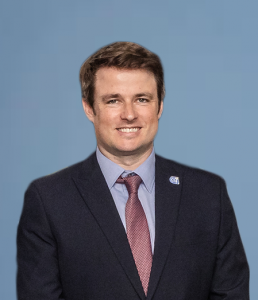
Meet the people who make up STEM Faculty.

David is a Senior Lecturer in Physical Sciences at the Open University and Director of the Centre for Electronic Imaging (CEI) which is a collaboration between the Open University and Teledyne e2v. Teledyne e2v are a world-leading technology company that offer space imaging solutions, including space-qualified imaging sensors, arrays and sub-systems for space science, ground astronomy and Earth observation, helping to solve the mysteries of the Universe and understand climate change on Earth.
David received an Honours Degree in Physics (MPhys) from Oxford University, UK, in 2006. Following his Masters, he completed his PhD on the impact of detection physics in X-ray CCD imagers and spectrometers from the Open University in 2010 in an industry-sponsored studentship with Teledyne e2v. Appointed as an e2v Research Fellow in 2010 and Lecturer in Physical Sciences in 2017, he has continued his research with the Centre for Electronic Imaging into the space radiation environment and its impact on space imaging and spectroscopy systems such as CCDs, being appointed as Director of the Centre for Electronic Imaging in January 2024, managing a grant portfolio of around £10M.
David has worked towards the ESA Gaia, Euclid and Athena missions, the ESA and Chinese Academy of Science SMILE mission, NASA's WFIRST mission, instrument background and graded-Z shielding, p-channel device technology and the fundamental physics of radiation damage in silicon and how this impacts the lattice. His research also focusses on the use of device-based simulations, including the modelling of CCDs and novel imaging techniques, alongside the simulation of instrument background, from XMM-Newton to ATHENA. David has developed collaborations with the Swiss Light Source at the Paul Scherrer Institute (Switzerland) and the Diamond Light Source (UK) towards the development of applications for the Electron-Multiplying CCD in synchrotron-based research and medical imaging, developing other applications for technology and techniques originally designed for space science.
David is a member of the Discovery Advisory Committee for Science
(DACS), as well as the UKRI Future Leaders Fellowships sifting and
interview panels.
A list of publications in print can be found on the Publications tab, which provides links to downloadable copies of all papers. Further information and bibliometrics are available through David's Google Scholar Profile.
If you are interested in any of David's research, publications or projects, or if you would like to collaborate in the future, please contact him at the email address on the left.
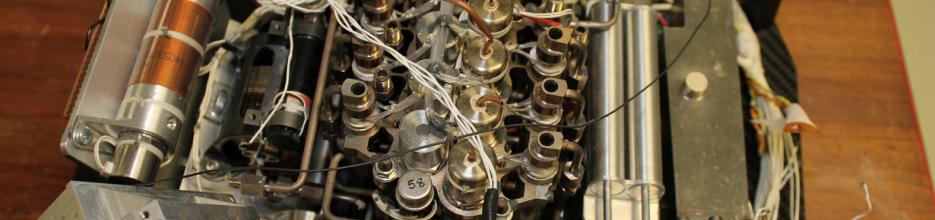
Instrumentation development and study of the underlying physical processes for detectors in space science and synchrotron research:
David has developed his experience in teaching at the Open University across a variety of areas. He has taken on the role as a "topic specialist" in a range of areas of the Open University "Practical Science" course in Physics and Astronomy, from NMR to Probing the Electron. He has also written course materials for the final project for students in the course, revolving around mathematical modelling through teamwork in distance learning.
David also worked as part of the team developing the OU's new Space Science Masters course, combining his research experience working on Gaia and teaching experience on the Practical Science and Research Skills Masters courses, providing students with a real-life research problem to solve and enabling them to contribute to the analysis of Gaia data alerts.
Alongside his work on the Space Science Masters, David has also been heavily involved in the presentation and production of the level 3 course on Electromagnetism, including the development of the next generation of the course.
As Director of the Centre for Electronic Imaging (CEI), David often collaborates with Teledyne e2v. This collaboration between academia and industry ensures that the research undertaken has real and tangible impact to UK industry. The collaboration agreements in place between Teledyne e2v and the Open University enable a much more in-depth study of the device physics than would otherwise be possible, bringing great benefits to space science and synchrotron applications.
David ran a very successful outreach project on the UKube-1 mission under funding from STFC's Science in Society scheme, reaching over 1,200 local school pupils in the first year of operation. The equipment and materials developed in this project are still being used in outreach activities in local schools, colleges and amateur interest groups, as well as for external visitors to the CEI laboratories.
David is working across a variety of projects in many collaborations in academia across the UK and Europe (e.g. MSSL, Durham, IoA Cambridge, ONERA, PSI), with industry (e.g. e2v, XCAM) and with the space agencies (e.g. ESA, UKSA). Alongside these European partnerships, David is also working with collaborators in the US such as those at the Jet Propulsion Laboratory.