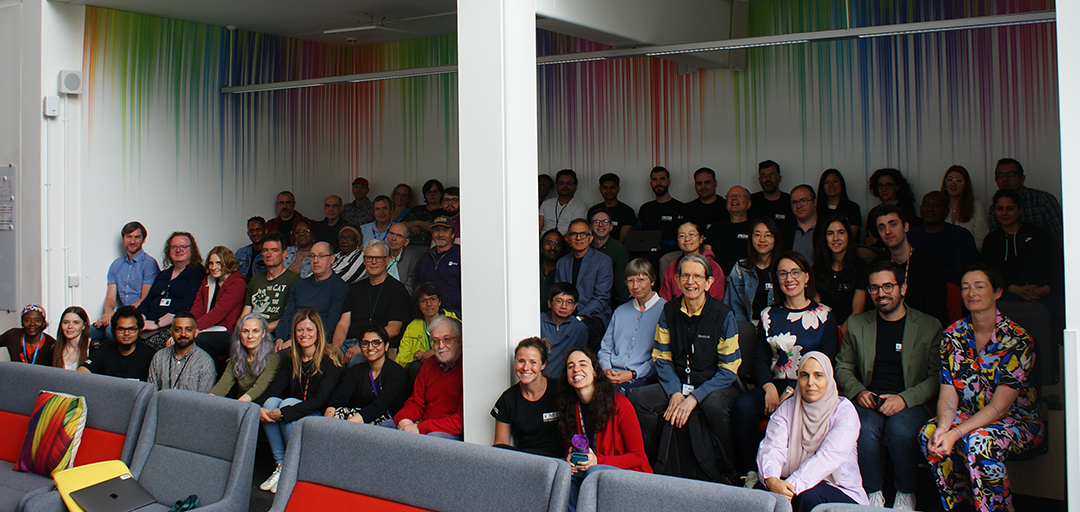
Meet the people who make up STEM Faculty.

Clara Mancini, PhD, is Professor of Animal-Computer Interaction (ACI) and founding head of the OU’s ACI Laboratory. Her work investigates the interaction between animals and technology; and the nexus between technology, animal wellbeing and justice, and human-animal relations. Her research spans the theory, methodology, practice and ethics of designing animal-centred interactive systems for and with animals, to help inform a more equitable and inclusive multispecies society.
Clara has led and supervised a range of ACI projects to benefit managed and wild animals. Her work has reframed human-centred concepts to develop more inclusive multispecies approaches as well as translated ACI concepts to develop animal-centred research and design approaches beyond the ACI field. Her collaborations with industry and NGOs have resulted in practical innovations, including for example interfaces to support the work of bio-detection dogs, dog-friendly controls to support the work of mobility assistance dogs, screen-based games to monitor and foster the cognitive health of companion dogs, interactive environments to enhance the welfare of rescued tigers.
Clara has published extensively in the leading peer-reviewed computing, interaction design, animal computer interaction, and animal behaviour and welfare journals and conference proceedings. She has lectured and refereed on ACI research worldwide. Her work has been brought to broad audiences through public lectures and exhibitions - including for HM Queen Elizabeth II - and she has appeared in national and international media, including print, radio, television and film.
Clara is a co-founder of the ACI International Conference and for over a decade has been promoting animal-centred research and design across disciplines by organising numerous scientific events and by serving on various scientific committees. In recognition of her contributions to ACI, in 2023, she received the inaugural Outstanding Career Impact Award created by the ACI Steering Committee on occasion of the ACI Conference’s tenth edition.
Clara is interested in developing theory that can inform the study and design of animals’ interactions with technologies, whether these are direct or indirect, dyadic or distributed, intentional or unintentional, cognitive or physical, co-located or remote, synchronous or asynchronous.
A core interest of hers is designing animal-centred interactive systems and, specifically, investigating how to design technological interventions (from single devices to whole environments) that enable animals to make sense of and interact effectively with their surroundings to pursue their biological goals consistent with their evolutionary and individual characteristics.
Clara’s work also focusses on the development of structured and unstructured methods for enabling animals to participate in the design process, based on their spontaneous interactions with their habitual environment and their behavioural and physiological responses to prototypes, and the qualitative and quantitative data these produce.
Another key interest of Clara’s is developing frameworks and practices for working ethically with animals as co-designers and research participants, to effectively support animal-centred research and design, also with a view to exporting ACI’s animal-centred values and principles to other fields of knowledge and practice, to foster a more ethical and sustainable technological development and the emergence of a more equitable and inclusive multispecies society.
Clara has supervised doctoral research on a range of ACI projects, including the design of dog-centred alarms for medical alert dogs, wearable-centred biotelemetry for companion animals and wildlife, interactive acoustic enrichment for captive elephants, dog-centred controls for mobility assistance dogs, and dog-centred AI approaches to support the work of bio-detection dogs.
Clara chairs the School’s Level 3 undergraduate module on Interaction Design and the User Experience. The module teaches how to study and design interactive systems that can enhance users and other stakeholders’ lived experience.
Through the delivery of interaction design theory and project work, the module provides tools to undertake the interaction design cycle, keeping the user’s experience always at the centre of the process. It provides concepts and methods for collecting and analysing data, to iteratively identify design requirements, inform appropriate designs and evaluate resulting prototypes, focussing on users and other stakeholders’ characteristics, their activities and the environments in which these take place.
Clara has been working with leading UK charities and companies to develop animal-centred applications and products for enhancing animals’ well-being and human-animal relations.
For example, in collaboration with UK Charities Dogs for Good and Petplan Charitable Trust, she has led the development of dog-centred wireless controls to facilitate the work of assistance dogs who are trained to interact with the environment on behalf of their assisted humans. In collaboration with Ravencourt Ltd., these are now becoming a commercial product, the Dogosophy Button, for charities training assistance dogs, for their clients and for the general public.
In collaboration with UK charity Medical Detection Dogs, she has led the development of an interaction technology to enhance the work of bio-detection dogs. The technology, which records the interaction between the dogs and the biological sample they screen to help understand the dogs’ response to the presence of diseases such as cancer, bacterial or viral infection, is currently used by Medical Detection Dogs for their research projects.
Clara and her team have also collaborated with UK company Care for the Rare Ltd. and international animal welfare charity Four Paws, to develop an interactive environment to enhance the welfare of rescued tigers. The technology enables the dynamic reconfiguration of one of the tigers’ maze-like enclosure to create different routes to a variety of resources, providing opportunities for meaningful movement guided by acoustic, visual and olfactory signals in response to choices made by the animals. The most complex interactive system ever to be developed to enrich the lived experience of captive animals, this permanent installation is being deployed at Four Paws’ sanctuary Tierart in Germany.
Clara's work has been featured at major public events, such as the Royal Society Summer Science Exhibition and the Edinburgh International Science Festival, and has been demonstrated at Buckingham Palace, for HM Queen Elizabeth II. The ACI Laboratory’s work has repeatedly featured in the national and international media.
Clara has collaborated with other academic institutions, companies and charities, both nationally and internationally, on a range of ACI research and development projects.
Academic collaborators have included, for example, University of Lincoln (UK), University of Edinburgh (UK), London Metropolitan University (UK), Royal College of Arts (UK), University of Turku (Finland), University of Nottingham (UK), University of Haifa (Israel), Technion Tel Aviv (Israel), University of Bologna (Italy), Texas A&M University (USA).
Industrial collaborators include Retrieva Tracking (UK), Care for the Rare (UK), Admedia Innovation and Technology (Portugal), Ravencourt (UK), Joypaw (UK), Parrot Kindergarten (USA).
Collaborating charitable organisations include Dogs for Good (UK), Medical Detection Dogs (UK), Pet Plan Trust (UK), Four Paw (Germany).
In addition to various international research collaborations, Clara regularly works with members of the ACI international community to support the development of the field. She is a co-founder of the International Conference on Animal-Computer Interaction, and has repeatedly served as a general chair, program chair and program committee member. She is also a founding member of the ACI International Steering Committee.
As a part of her editorial commitments, she is Associate Editor of the international journal Frontiers in Veterinary Science, Animal Welfare section, to which she brings the perspective and values of animal-centred computing research and design.