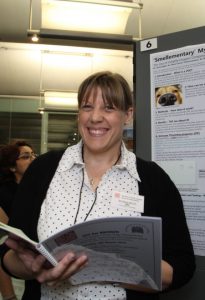
Meet the people who make up STEM Faculty.

I am currently a PDRA investigating volatile organic compounds (VOCs) as putitive biosignatures for life. This includes exploring how VOCs interact in extreme environments termed 'analogue sites' (as they resemble those that could exist on other planetary bodies) and with extremophile microbes. I am interested in how the environmental VOCs and those produced by the microbial life itself influence the surroundings and each other. This could give us key information on how to detect them on other planetary bodies by looking for entire patterns of VOCs and not just individual biomarkers. By combining this volatile or 'volatilomic' data with metagenomic, metabolomic and transcriptomic data we can build a full picture of how life exists and persists in extreme conditions. It also gives us a great baseline to compare any mission data that comes back.
I am also investigating VOCs in relation to molecular organic contamination (as part of planetary protection protocols). This involves analysing potential contamination in cleanrooms and the bonding materials (usually silicone based) that are used to adhere components on flight hardware. I completed an STFC-IAA project in 2022 to initially investigate this and this year have a PhD student starting a 3.5 year STFC CASE studentship with Airbus Space & Defence to investigate it further.
The amazing thing about VOC analysis is how the application can move from one area (medical diagnostics) to another (Astrobiology) and still follow similar metabolic pathways and chemistries which when once could determine disease, now could determine life.
I have also recently been made an Associate Member of the Royal Society of Chemistry (AMRSC).
I joined AstrobiologyOU as a post doc after maternity leave and just as the pandemic and lockdown was rearing its ugly head! But luckily it has led to a wealth of opportunities and exciting research.
I started my career in Osteopathic Medicine which involved treating patients in both private clinics and the NHS, as well as working with sporting teams to provide medical care, and teaching a sports massage and rehabilitation diploma. Although I loved the variation in this job, I decided to expand my knowledge even further (because obviously I didn’t have enough to do!) and enrolled myself on a part-time MSc research degree.
I completed said MSc at Cranfield University in Medical Diagnostics and this is where I first got interested in metabolic compounds that could be used as indicators for things like disease. An opportunity arose to then expand on this area by doing a PhD at the Open University (OU) with Professor Claire Turner and Professor John Hunter (Addenbrookes Hospital) on the ‘Use of VOC Profiling in Investigating Diseases of the Gut and Diet Related Conditions’. This is where my introduction to VOCs blossomed, and I developed skills in Nuclear Magnetic Resonance (NMR), thermal desorption (TD), gas chromatography mass spectrometry (GC-MS), and selective ion flow tube mass spectrometry (SIFT-MS).
While doing my PhD I was involved with ‘The Brilliant Club’ – teaching school age students about my research – which opened my eyes to encouraging under-represented groups in schools to be confident in applying to highly-selective universities. Standing on a soapbox was also required – by being in the first group to present at Milton Keynes’ public outreach platform ‘Soapbox Science’ event. Since then I have been involved in a number of AstrobiologyOU outreach events including 'ask the expert' and a schools event in Dumfries - 'Bang Goes DG!'.
Two previous PDRA roles also led me into VOC analysis using optical fibre technology, 3D printing diagnostic platforms, and organic compound and surface variation analysis using reflectance UV-spectrophotometry. I also formely taught as an associate lecturer for the OU on their SK299 module – human biology.
Working at the OU has also allowed me to expand on local and international collaboration in the UK (Nottingham University, Cranfield University, University of the West of England, Addenbrookes Hospital, Guy’s Hospital Kings College London, Tharos Ltd) and Japan (The University of Kitakyushu) as well as starting to build industrial links and commercial relationships. Hopefully my current expertise will allow me to further expand my knowledge into the many wonderful corners of Astrobiological research and knowledge exchange.
Displaying 10 of 19 publications