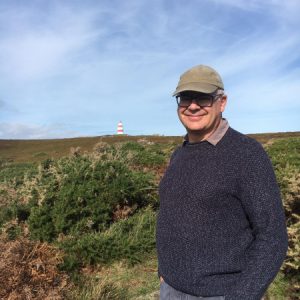
Meet the people who make up STEM Faculty.

B.Sc. (Hons) "Physics with Astrophysics" 1st class, Leicester University (1985)
Ph.D. "Galactic X-ray Astronomy with EXOSAT" Leicester University (1988)
PhD Supervisors: Mike Watson & Bob Warwick; Examiners: Ken Pounds & Keith Mason
Roles:
Emeritus Professor, School of Physical Sciences, OU (2026 - current)
Professor of Astrophysics Education, School of Physical Sciences, OU (2013 - 2025)
Senior Lecturer in Astrophysics, Dept. of Physics and Astronomy, OU (1999 - 2013)
Lecturer in Astrophysics, Department of Physics, OU (1992 - 1999)
Research Fellow, Dept. of Physics and Astronomy, U. Southampton (1988 - 1992)
Other Open University roles:
Undergraduate Qualification Lead for Physics, Astronomy & Planetary Science (2022 - 2025)
STEM Media Fellow (2023 - 2025)
External Examiner Training Facilitator (2024 - 2025)
Deputy Head of School (internal affairs) (2019 - 2023);
SPS Postgraduate Tutor (recruitment) (2017 - 2019);
SEPNet Academic Outreach Officer and Coordinator (2013 - 2015);
Assoc. Prog. Director for Physics and Astronomy & Planetary Science (2008 - 2014);
Departmental Director of External Relations (2003 - 2006);
Curriculum Director for Astronomy and Planetary Science (1999 - 2003);
Director of Research for Department of Physics and Astronomy (1998 - 2001).
I previously served:
as Editor-in-Chief of the journal Astronomical Review, (2015 - 2018),
on the STFC Advisory Panel for Public Engagement (2015 - 2018),
as Director of the OU's George Abell Observatory (1998 - 2025).
Professional memberships:
Fellow of the Royal Astronomical Society.
Vice President (2013 - 2015); Council Member (2010 - 2013);
Membership Committee (2010 - 2013); Diversity Committee (2013 - 2016)
Education & Outreach Committee (2013 - 2015); Ballot scrutineer (2017 - 2020)
Fellow of the Institute of Physics
Senior Fellow of the Higher Education Academy. (AdvanceHE)
Member of the International Astronomical Union
Division C - Education, Outreach and Heritage: Commission C2:
Communicating Astronomy with the Public;
Division F - Planetary Systems and Bioastronomy: Commission F2:
Exoplanets and the Solar System;
Division G - Stars and Stellar Physics: Commission G1:
Binary and Multiple Star Systems.
STEMNET Ambassador and Public Engagement Ambassador
for the National Co-ordinating Centre for Public Engagement
Awards:
Research: The Royal Astronomical Society Group Achievement Award (2010) as part of the SuperWASP consortium.
Teaching: The Royal Astronomical Society Higher Education Award (2025) for designing, writing and delivering the Open University’s Astronomy curriculum over the last 25 years, reaching tens of thousands of distance learning students
An Open University Team Award (2016) for the production and first presentation of S217 Physics: from classical to quantum.
An Open University Teaching Award (2010) for "Outstanding contributions to the teaching of astronomy and astrophysics, particularly through the use of innovative materials and methods."
Public Engagement: A SEPnet Public Engagement Award (2015), "Highly Commended" in the Achievement category, for my extensive body of public engagement.
The IAU have named Asteroid 1997 WU35 as 10230 AndrewNorton
Wordle cloud of my CV:

A complete bibliography of all my published work is available, containing links to downloadable PDF files. As well as refereed journal articles and conference papers, this list also includes text books, videos, TV programmes, software packages, experiment designs and printed or online outreach articles that I have produced. A set of citation statistics is also available.
A public talk I gave as part of the OU@50 clebrations on The Clockwork Universe is available on the School of Physical Sciences' YouTube channel.
My Research interests include:
I was co-Chair of the 2004 RAS National Astronomy Meeting held at the OU.
I was a founder member of the SuperWASP project and a founder member of the UK consortium which is a shareholder in the Southern African Large Telescope. I was the founder and editor of the international Exoplanet Newsletter for its first 100 editions.
Postgraduate students (with their completion date & thesis titles) for whom I was lead (or co-lead) supervisor:
* Winner of the AOUG Sir John Horlock Award for Science
§ Winner of the AOUG Will Swann Award for Innovation and Knowledge Development
I was second or third supervisor for a further 22 OU PhD/MPhil students (Stephen Mills, David Arnot, Zachary Amato, Joe Reale, Oleg Kozhura, Helen Usher, Mark Salisbury, Meredith Morrell, Pam Rowden, Calum McCune, Enda Farrell, Robert Farmer, Karl Wraight, Jon Dawson, Fraser Lewis, Vanessa Stround, Philip Davis, Ben Eves, Craig Powell, Rob Mundin, John Barker & Dave Lott) and acting supervisor for 2 OU PhD students (Becky Enoch & Amanda Smith) during maternity leave cover.
I served as PhD/MPhil/MSc examiner for 18 OU students and 33 external students at institutions including: Durham University, Keele University, Leicester University, Liverpool John Moores University, Oxford University, Queens University Belfast, Southampton University, University of Central Lancashire, University College London, University of Hertfordshire, Warwick University, the University of Cape Town and Alicante University. In addition I have been PhD viva chair for a further 21 OU students.
I was the Undergraduate Qualification Lead for Physics and Astronomy & Planetary Science. from 2022 to 2025. Previously, from 2008 until 2014 I was Associate Programme Director for Physics and Astronomy & Planetary Science, overseeing the content and presentation of the Physical Science curriculum at the OU. I developed the Physics and Astronomy & Planetary Science pathways through the OU's BSc (Hons) Natural Sciences degree and led the process by which the Institute of Physics accredited a route through our qualifications suitable for students wishing to obtain Chartered Physicist status.
Here's a 2 minute video I made on "Why study physics?"
My teaching interests recently focused on:
In the past I was involved with:
I was External Examiner for the distance learning Astronomy MSc programme at Liverpool John Moores University from 2018 - 2021. I previously served as External Examiner for the School of Physics and Astronomy at Manchester University from 2008 - 2011 and External Examiner for the School of Physics and Astronomy at Southampton University from 2012 - 2017. I also acted as External Assessor for the Physics with Astrophysics degree at Warwick University (2018); External Reviewer for material produced by Oxford University Department of Continuing Education (2011); carried out External Validation of the Observational Astronomy degree at the University of South Wales (2014), and was External Advisor on the approval panel for the “Gateway to Science” programme at Cornwall College for the provision approved by Plymouth University (2016).
I was one of two External Examiner Training Facilitators for the OU, having completed the Advance HE External Examiner Personal Development Course.


As STEM Media Fellow, I liased between the three science schools of the STEM Faculty (i.e. LHCS, EEES and SPS) and the OU Broadcasts & Partnerships Office for BBC commissions, as well as with OpenLearn for free courses, videos and articles. In this role I have supported the following recent and forthcoming TV & Radio broadcast projects: Spring Watch (2023, 2024, 2025), Wild Isles (2023, 2025), Earth (2023), Inside Science (2023, 2024, 2025), Planet Earth 3 (2023), Rare Earth (2024, 2025), Secrets of the Brain (2025), Disease X (2025), Once upon a time in Space (2026), Secret Garden (2026), Forensics - the Real CSI (2024, 2025), Evolution (2026), Blue Planet 3 (2026), Wilderness (2026), Hidden Planet (2027), and Green Planet 2 (2028). I helped produce BBC Ideas films on How to solve the Plastic problem (2024) and How the quantum revolution will change our lives (2024), as well as their related OUConnect infographics Different types of Plastics (2024) and Quantum Computing: A New Era of Possibilities (2024). I also led development of various OpenLearn content, including: Sustainability Hub v2 (2024); S111 Questions in Science videos (2024); and new courses based on extracts from S284 Images of the Universe, SM380 Quantum computing, SM381 Coulomb's law, S384 The Formation of Exoplanets & White dwarfs and Neutron stars, and S385 Unsolved Problems in Cosmology.
I have written a popular science book "Understanding the Universe: the Physics of the Cosmos from Quasars to Quarks" which is published by CRC Press (Taylor & Francis Group). The book explores how all areas of physics, from the very smallest scales to the very largest, come together to form our current understanding of the Universe. It takes readers on a fascinating journey, from the Big Bang and how the Universe has evolved, to how it appears now, and the possibilities for how it will continue to evolve in the future. It also explores the latest exciting developments in the area and how they impact our understanding of the Universe, such as quantum chromodynamics, black holes, dark energy, and gravitational waves. Equally importantly, it explains how we have come to know all of this about the Universe and details the limitations of our current understanding. This book is accessible to all introductory undergraduate students interested in the physical sciences. It prioritises a non-mathematical approach so it can be understood by all students, with only two algebraic equations in the book and any numerical calculations shown are limited to simple arithmetic.
I also wrote "A Multi-Wavelength History of Astronomical Surveys: All the Sky - All the Time" which is also published by CRC Press (Taylor & Francis Group). The book presents an accessible history of astronomical surveys across the electromagnetic spectrum and beyond. Beginning with classical visual surveys of the sky, it then moves on to surveys using telescopes in the 17th century onwards, those using photographic images in the 19th century onwards, and then the incredible expansion of techniques in the 20th century to the present day. where surveys now look beyond visible light into other regions of the electromagnetic spectrum (including radio, microwave, infrared, ultraviolet, X-ray, and gamma-ray regimes). Recent surveys also make use of electronic detectors, as well as space-based telescopes, to complement those on the ground. More than 350 surveys and catalogues encompassing imaging, astrometry, photometry, and spectroscopy are all comprehensively described. Chapters also go beyond electromagnetic radiation to discuss other forms of astronomical surveys, including those using neutrinos, cosmic rays, and gravitational radiation. This book also considers the range of online meta-catalogues and data archives that now exist and reflects on recent developments in machine learning and citizen science that are necessary to deal with astronomical “big data”. Interspersed within the chapters are a series of feature boxes that explain the exciting astrophysical concepts and phenomena revealed by surveys. This format enables the book to be read by anyone with an interest in astronomy, even if they have not previously studied the astrophysics of the objects that make up the Universe. This book is non-mathematical in nature and can also be used as an introduction to the tools and practices of astronomy for undergraduate science students.
I was deputy organiser of the exhibit "Is there anybody out there? Looking for new worlds" at the 2008 Royal Society Summer Science Exhibition, led by Carole Haswell.
I worked with Katarzyna Krzyzanowska and Silvia Bergamini to produce two board games based around quantum technologies entitled "Lab-Labyrinth" and "Quantum Enigma". For the latter game - see this promotional video and this video illustrating the gameplay.
Here are some cartoons I made with Stephen Serjeant and Dave Rothery on "60 second Adventures in Astronomy". They were nominated for an Arthur Award in 2013 and won a prize at the 36th annual TELLY Awards in 2015; they have now received over 500,000 individual views. Here's a 10-minute lecture on "Exoplanets and how to find them" that I presented as part of the OU's schools' christmas lectures in 2013. In 2011 I wrote a children's story book about exoplanets: "Oogle Flip and the Planet Adventure" which was a finalist in the 2012 Golden Duck Awards for excellence in children's science fiction literature.
I was a frequent Academic Consultant for OU/BBC astronomy co-productions, recently including Universe presented by Brian Cox (2021). Related to this, I helped produce a video for BBC Ideas called "How big is our Universe?" which updates the famous "Powers of Ten" film made by the Eames Corporation in the 1970s, and produced an infographic on "5 big questions about the Universe" as well as an associated narrated commentary explaining the answers . In the past I have also worked on Stardate and The Cosmos: a Beginners Guide (both presented by Adam Hart Davies) as well as Bang Goes the Theory: the Drake Equation (presented by Dallas Campbell). I also supported the 2012 & 2013 series of StarGazing Live! (presented by Brian Cox & Dara O'Briain) and the programmes Light and Dark (presented by Jim Al Khalili).
My profile on OpenLearn includes many articles I've written including ones about the science of Dr. Who and Star Trek. I have also written several articles for The Conversation.
As part of the OU's outreach and public engagement activity aimed at widening participation in physics and astronomy amongst under-represented groups, I have presented talks to schools and other youth groups, and to Astronomical societies, the U3A, the WI and other adult groups. I have also given talks to other general audiences at science festivals and museums, including the following:
My background
Everyone has a different route to where they end up, and the great thing about the OU is that it offers education to everyone. Both my grandfathers were engine drivers and my parents both left school at age 14 or 15 with no qualifications. Tracing my family back through 10 generations to 1700, I get a long line of illiterate Lincolnshire farm labourers, so no great academic achievements there. I went to a village infant school with only a dozen pupils per year group and then a rural Lincolnshire comprehensive school, whose headmaster's specialist subject was woodwork. I did pretty well at school - I was the only person in my year of 240 kids to get 8 grade "A" at O-level, and was one of about 30 who stayed on for A-levels, where again I did ok. The school didn't have a great tradition of sending pupils to university, having been a so-called secondary modern school (i.e. non-grammar school) until a few years previously, and never sent anyone to Oxbridge until long after I left. I was the first in my family to go to university and ended up at Leicester University studying Physics with Astrophysics, which suited me very well, and finished as one of half-a-dozen students with a first class degree in my year group. So I stayed on there to do a PhD in X-ray Astronomy, as I didn't really have a better idea of what to do. Following that I did a postdoc research job for 4 years at Southampton University and then applied for a not very fashionable 3-year lectureship job at the OU where Jocelyn Bell Burnell was trying to expand the Physics Department to include some astronomers. Luckily my previous experience teaching adult education (night school) classes in my spare time at Southampton impressed the OU, and I've been here ever since, doing all the things listed above. I'm grateful to be part of the OU and able to help others along their own academic journeys.
My Erdös - Bacon - Sabbath number is 13.
Scientific papers: I have an Erdös number of no more than 4: I have co-authored with Lars Bildsten, who co-authored with George Djorgovski, who co-authored with Jogesh Babu, who co-authored with Paul Erdös.
Film or TV programmes: I have a Bacon number of no more than 4: I have appeared on screen (in "Stardate: Transit of Venus") with Adam Hart Davis, who has appeared (in "Stardate: Mysteries of Venus") with Myleene Klass, who has appeared (in "Monk Dawson") with Rhona Mitra, who has appeared (in "Hollow Man") with Kevin Bacon.
Musical performance: I have a (tenuous) Sabbath number of no more than 5: I played one note on my saxophone in an OU video "Seeing Inside the Sun" directed by Anne-Marie Gallen, who directed an OU programme "The Riddle of the Dome" narrated by Andrew Sachs, who was part of the cast recording of "Fawlty Towers" with John Cleese, who was in various "Monty Python" recordings with Eric Idle, who recorded the "Childrens Promise" charity album with Ozzy Osbourne, who of course was in Black Sabbath.
Academic Connections
See my Academic Family Tree - here's one lineage from it (research supervisors / advisors / mentors):
Me (1988, Leicester) ⇒
Mike Watson (1979, Leicester) ⇒
Ken Pounds (1961, UCL) ⇒
Sir Harrie Massey (1932, Cambridge) ⇒
Sir Ralph Fowler* (1913, Cambridge) ⇒
Lord Ernest Rutherford (1897, Cambridge) ⇒
Sir JJ Thomson (1880, Cambridge) ⇒
John Strutt, Lord Rayleigh (1865, Cambridge) ⇒
William Thomson, Lord Kelvin (1846, Cambridge) ⇒
William Hopkins (1830, Cambridge) ⇒
Adam Sedgwick (1811, Cambridge) ⇒
Thomas Jones (1782, Cambridge) ⇒
Thomas Postlethwaite (1753, Cambridge) ⇒
Stephen Whisson (1742, Cambridge) ⇒
Walter Taylor (1723, Cambridge) ⇒
Robert Smith (1714, Cambridge) ⇒
Roger Cotes (1706, Cambridge) ⇒
Sir Isaac Newton (1668, Cambridge).
*Nb. Fowler's formal advisor was not Rutherford (he was his father-in-law), but they worked closely together and Rutherford was a mentor to Fowler.
Also, Ralph Fowler was at the famous 1927 Solvay Conference (below, back row, second from the right). So I'm no more than 4 handshakes away from Albert Einstein, Maire Curie, Max Planck, Erwin Schrödinger, Werner Heisenberg, Wolfgang Pauli, Niels Bohr, Louis de Broglie, Paul Dirac, etc.

Displaying 10 of 172 publications